
Search Colleges, Exams, Schools & more


Login
CUET GAT Question Paper 2026 Analysis: Memory-Based Questions & Difficulty Level
The National Testing Agency (NTA) has successfully wrapped up the CUET UG 2026 examination, including the General Aptitude Test (GAT) paper that was held across multiple shifts. Candidates can now view the detailed shift-wise CUET GAT 2026 exam analysis on this page, which covers the overall difficulty level, important topics that were asked, the question pattern, and student reactions from each exam day. Based on student feedback and expert CUET 2026 exam analysis , the overall difficulty level of the CUET UG 2026 GAT paper was moderate, with a fairly even mix of logical reasoning, quantitative aptitude, general knowledge, current affairs, and analytical ability type questions. Since GAT blends several parts together, the paper basically checked both speed and precision , so it ended up being one of the most varied sections in the CUET exam. On this page you’ll find the CUET GAT 2026 memory-based questions, plus a detailed shift-wise breakdown, and student reactions, so candidates can get a clearer feel for this year’s exam pattern and topic-wise weightage. The CUET 2026 GAT question paper along with solutions will be updated here soon too. Students can also look at the analysis for other CUET 2026 subjects , in order to compare paper trends and review the overall exam pattern across different streams.
This Story also Contains
- CUET UG 2026 GAT Analysis - Day-wise Shift 1 vs Shift 2 Comparison
- CUET General Test (GAT) Question Paper 2026 Analysis
- Subject-wise CUET 2026 Exam Analysis PDF
- GAT CUET 2026 Question Paper with Solutions PDF
- GAT CUET 2026 Memory-Based Questions
- Important Topics Covered in GAT CUET 2026
Candidates looking for detailed Exam Analysis can download: GAT CUET 2026 Exam Analysis and Memory-Based Questions
CUET UG 2026 GAT Analysis - Day-wise Shift 1 vs Shift 2 Comparison
| Date | Shift 1 Analysis | Shift 2 Analysis |
|---|---|---|
| 12 May | Moderate - GK had highest weightage; quant formula-based; reasoning lighter | Moderate - well-balanced; quant highest weightage |
| 14 May | Moderate - GK & Current Affairs dominant; history NCERT useful | Moderate - balanced paper; quant + reasoning + GK evenly spread |
| 18 May | Easy to Moderate - GK + Current Affairs highest; reasoning easy | Easy to Moderate - GK-heavy; quant & reasoning easier |
| 19 May | Moderate - static GK important; maths formula-based | Easy to Moderate - GK-heavy; fewer quant questions |
| 20 May | Easy to Moderate - balanced; reasoning & GK strong | Easy to Moderate - quant + reasoning dominant |
| 21 May | Moderate - quant + reasoning dominant; time-consuming | Easy to Moderate - balanced and scoring |
| 22 May | Easy to Moderate - static GK highest; chronology-based questions important | Moderate - balanced mix of aptitude, reasoning & static GK |
| 24 May | Easy to Moderate - predictable paper; reasoning easiest | - |
| 25 May | Moderate - equal weightage to reasoning, maths & GK | Moderate - reasoning-focused; similar pattern to Shift 1 |
| 26 May | Easy to Moderate - balanced across all sections; GK slightly tough | - |
| 29 May | Moderate - factual GK + mixed aptitude | Easy to Moderate - reasoning easiest; static GK direct |
Overall Trend Summary
| Parameter | Observation |
|---|---|
| Easiest Shift | 29 May Shift 2 |
| Toughest Shift | 21 May Shift 1 |
| Most GK-Heavy | 18 May (both shifts), 19 May Shift 2, 22 May Shift 1 |
| Most Quant-Heavy | 12 May Shift 2, 20 May Shift 2, 21 May Shift 1 |
| Most Reasoning-Scoring | 24 May Shift 1, 29 May Shift 2 |
| Most Balanced Paper | 20 May Shift 1, 22 May Shift 2, 26 May Shift 1 |
Section-Wise Pattern Across All Days
| Section | Overall Trend |
|---|---|
| General Knowledge / Current Affairs | Highest weightage in most shifts; static GK dominated over current affairs |
| Quantitative Aptitude | Mostly formula-based and manageable; arithmetic most frequent |
| Logical Reasoning | Most scoring section overall; repeated question types across shifts |
Confused About College Admissions?
Get expert advice on college selection, admission chances, and career path in a personalized counselling session.
Book a Counselling Slot
Select Date
Pick a Slot
CUET General Test (GAT) Question Paper 2026 Analysis
Below is the detailed analysis of the GAT 2026 Question Paper.
CUET UG 2026 GAT Analysis - 31 May Shift 1
The overall difficulty level of the paper was easy to moderate, with many students describing it as manageable and scoring-friendly.
The General Knowledge (GK) section had around 20 questions. Most questions were factual and based on static GK.
Questions in GK were asked from topics such as:
Indian Constitution – Date of adoption of the Constitution (26 November 1949)
Article related to National Capital Territory Delhi
Government schemes – Skill India, Beti Bachao Beti Padhao, Digital India, Make in India
History chronology – Dandi March, Chauri Chaura Incident, Morley-Minto Reforms, Montagu Reforms
East India Company – First factory in India during the reign of Jahangir
Book & Author – Malgudi Days by R.K. Narayan
European Union members
World rivers
Classical dances of South India
Dams and rivers matching
The Quantitative Aptitude section was formula-based and considered straightforward by students with basic preparation.
Quant questions were asked from:
Probability – around 2 questions
Simple Interest and Compound Interest
Permutation & Combination
Time and Work
Height and Distance
Mensuration (3D) – arranging volume in decreasing order (cube, cuboid, sphere, cylinder)
Statistics – range, variance, standard deviation, mean deviation
Number-based series and multiples
The Logical Reasoning section was easy and included familiar question types.
Reasoning topics included:
Blood Relations
Direction Sense
Clock-based questions
Calendar
Coding-Decoding
Non-verbal reasoning (3–4 figure-based questions)
Several students reported that the questions were direct and concept-based, with very little tricky or lengthy calculation involved.
Students mentioned that time management was comfortable, especially because many GK questions were one-step factual questions.
According to student reactions, candidates with clear basic concepts and regular practice in Quant and Reasoning found the paper easy to attempt.
Experts noted that the paper did not go very deep into complex concepts; instead, it focused more on basic formulas, static GK, and standard reasoning patterns.
Overall, Shift 1 was considered a balanced and doable paper, and many students expect a good score in this shift.
CUET UG Subject-wise Question Bank 2027
Download the CUET UG 2027 Subject-Wise Question Bank PDF to practise important questions, strengthen concepts, improve speed and prepare effectively for CUET.
Download EBookCUET UG 2026 GAT Analysis - 29 May Shift 2
Reasoning
Reasoning section was quite easy
Coding-Decoding question based on Alphanumeric pattern was asked
Calendar question was asked
Blood Relation question based on symbols was asked
Question on Mirror Image of the word "HINT" was asked
Direction-based question was asked
Clock question was asked
Seating Arrangement question was asked
General Knowledge
Question on international rivers, including the Amazon, was asked
Question on the Green Revolution was asked
Question on the Five-Year Plans was asked
Sequence-based question on Prime Ministers was asked
Question on Indira Gandhi was asked
Question on the 1974 Railway Strike was asked
CUET UG 2026 GAT Analysis - 29 May Shift 1
The paper level was moderate.
RBI Anniversary: The Reserve Bank of India (RBI) was established in 1935; how many years had it completed by 2024?
Nuclear Tests: India’s nuclear tests in 1998 led to the observance of which day?
Puducherry: In which part of India is Puducherry located?
History/Chronology: Provide a chronology for the implementation of the Doctrine of Lapse.
Vedic Studies: The Sangrahini Sutra is associated with what?
At which place is the primary facility launching? (for satellite)
How many years are there in total?
The Battery Waste Management Rules were published in which year?
Arrange the following chronologically: The Tribute System and the Doctrine of Lapse.
In which state and at which site is the structure of Vishnu reclining on Shesha found?
The Oscar Award 2024, “Godzilla Minus One”, was given for which category?
What are the three fundamental particles in an atom? How many characteristics does a living cell have?
What is an El Niño?
Alloys are a mixture of what?
What is the vegetation zone and temperature associated with it?
Which is the odd one out among the Concurrent List?
Symbols, letters, and signs are all found in what?
[Mirror Image] If a mirror is placed to the right of a figure, what will its reflection look like?
[Water Image] What is the water image of a figure?
[Coding-Decoding] If a language codes a word, what is its coded form?
[Odd One Out] Pick the odd one out among the given options.
[Average] Calculate the average of a given set.
[Speed & Distance] Calculate the time taken to cover a specific distance.
[Direction] Solve a problem regarding a person's displacement.
[Geometry] Find the angle formed by a line inside a figure with a horizontal line.
[Ratio] Solve for a ratio (e.g., a:b and b:c).
[Work & Time] How long will two people take to complete a task together?
CUET UG 2026 GAT Analysis - 26 May Shift 1
The GAT paper was easy to moderate overall.
The section had balanced weightage across Quantitative Aptitude, Logical Reasoning, and General Knowledge.
Quant questions were mostly formula-based but involved calculations.
Questions were asked from Geometry, including area comparison between shapes.
Arithmetic topics included Averages, Simple Interest vs Compound Interest, Work & Time, and Boat & Stream.
Logical Reasoning questions were manageable and based on familiar patterns.
General Knowledge was mostly factual and static, with questions from geography and basic science.
Students found the section scoring, though a few calculation-based questions were slightly time-consuming.
Reasoning
One question from Coding-Decoding was asked
One question each from Blood Relation and Direction was asked
One difficult question from Clock was asked
Question from Calendar was asked
Series question based on the pattern +2, +1 was asked
One question each from Mirror Image and Water Image was asked
One question each from Embedded Image and Ranking was asked
General Knowledge
Question on Khalsa was asked
Question on Rivers was asked
Question on PM MUDRA Yojana was asked
Question on Constitutional Amendment regarding voting age from 21 to 18 was asked
Question on Books and Authors was asked
GK portion was tough
Mathematics
Total 15 questions were asked from Mathematics
One question from Height and Distance was asked
Question on Probability based on Composite Numbers was asked
Question from Permutation and Combination was asked
Question from Coordinate Geometry on Equidistant point was asked
Question from Algebra was asked
Questions on Circle and Cube were asked
Match the Following question from Mensuration was asked
Question on Mean was asked
Questions from Time and Work and Train and Distance were asked
One question from Percentage was asked
One question from Ratio and Arithmetic Progression (AP) was asked
CUET UG 2026 GAT Analysis - 25 May Shift 2
Reasoning
Coding-Decoding question was asked
Blood Relation question was asked
Question on Direction Test was asked
Questions on Clock and Calendar were asked
Question “30 January 2007 was which day?” was asked
Questions from Alphanumeric Series and Letter Series were asked
One question each from Mirror Image, Water Image, Seating Arrangement, Embedded Picture, and Missing Character was asked
CUET UG 2026 GAT Analysis - 25 May Shift 1
Reasoning, Maths, and GK had almost equal weightage in this shift
Reasoning
Question on Series was asked
Coding-Decoding question based on “+1” pattern was asked
Blood Relation question was asked
Question on Direction Test based on distance was asked
Question on Ranking was asked
Question on Clock and Calendar was asked
Calendar question based on finding the day in 2018 with 2024 reference was asked
Questions on Mirror Image, Water Image, and Embedded Picture were asked
Question on Seating Arrangement was asked
Quantitative Aptitude (Both Shifts)
Around 13-15 questions were almost similar in both shifts
Questions from Mensuration were asked based on formulas of Circle and Triangle in Match the Following format
Questions from Height and Distance were asked in both shifts
From AP (Arithmetic Progression), questions on Number of Terms and Missing Terms were asked
Questions from Profit and Loss were asked in both shifts
Questions from Time and Work were asked in both shifts
Questions from Coordinate Geometry in Match the Following format were asked
Question from Probability was asked
Question from Permutation and Combination on arrangement was asked
Question from Train and Distance was asked
Question from Compound Interest was asked
One question from Mean Proportion was asked
Questions from Algebra were asked
CUET UG 2026 GAT Analysis - 24 May Shift 1
Overall GAT paper difficulty level was easy to moderate.
The paper followed the same pattern as previous shifts; no major changes were reported.
Question distribution was fairly balanced across:
Reasoning
Mathematics
General Knowledge / General Studies
Around 15-17 questions were asked from each section.
Reasoning Analysis
Reasoning section was easy and highly predictable.
Most questions came from repeated, familiar topics.
Coding-Decoding - 2 questions
One direct coding question
One alphanumeric coding question
Analogy - 1 question
Direction Test - 1 question
Blood Relation - 1 question
Calendar - 1 question
Clock - 1 slightly tricky question
Series - 1 question
Mirror Image - 1 question
Embedded Figure - 2 questions
Seating Arrangement - 1 question
Students found this section manageable with regular practice.
Mathematics Analysis
Maths in GAT was easy to moderate.
Questions were direct and formula-based.
No highly difficult calculation-heavy questions were reported.
Major topics included:
Number System
Arithmetic Progression (AP)
Geometric Progression (GP)
Mensuration
Compound Interest
Geometry
Permutation & Combination
Students who revised formulas properly found this section scoring.
General Knowledge / General Studies Analysis
GK/GS was the trickiest part of GAT.
Mix of static GK and current affairs was seen.
Major topics asked:
Freedom movements and their leaders
Books and Authors
Premchand-related question
150th birth anniversary related question
Constitution / Articles
2-3 Current Affairs questions
Geography had very low weightage in this shift.
Student Feedback
Reasoning was easy and repetitive.
Maths was straightforward and scoring.
GK was slightly confusing compared to the other two sections.
No unexpected pattern change was seen.
Students with previous-year question practice found the paper comfortable.
Overall GAT Insights
Overall Level: Easy to Moderate
Most Scoring Section: Reasoning
Moderate Section: Mathematics
Trickiest Section: GK / Current Affairs
Paper Trend: Similar to previous CUET GAT shifts, with repeated topic coverage
GAT Exam Analysis - CUET UG 2026 22 May Shift 2
The overall difficulty level of the GAT paper was moderate with a balanced mix of aptitude, reasoning, and static GK questions.
Reasoning section included questions from Blood Relations and Seating Arrangement, which were reported to be manageable and direct in nature.
Quantitative Aptitude had questions from Ratio and Proportion along with basic Trigonometry-based formula application.
General Awareness section focused more on static GK rather than current affairs.
Questions related to Seasonal Crops such as Rabi and Kharif crops were asked from basic Geography/Agriculture awareness.
Polity questions included topics related to Parliament’s Powers, indicating focus on NCERT-level constitutional concepts.
One science-based question was asked on the Unit of Sound, showing inclusion of elementary Physics GK.
Students felt that memorising formulas and revising static GK topics would have been more beneficial than focusing heavily on current affairs.
The paper was considered scoring for students with decent preparation in reasoning and school-level GK concepts.
No highly calculation-intensive or unexpected questions were reported in this shift.
CUET UG 2026 GAT Analysis - 22 May Shift 1
Overall paper level was easy to moderate.
Static GK had the highest weightage in the shift.
Current Affairs questions were limited but important.
Chronology-based questions were heavily asked.
Around 3-4 questions came from chronology and sequence arrangement.
General Knowledge & Current Affairs
Question asked on Arjuna Award winners in Hockey (2024).
Mars Orbiter Mission launch year was asked.
Rishi Sunak becoming UK Prime Minister was asked.
UNESCO World Heritage Site-related question appeared.
Union Territories after 2019 reorganization were asked.
National Park recognized as UNESCO site was asked.
Questions from Books and Authors were included.
Amitav Ghosh-related book question appeared.
Current Affairs weightage was lower than Static GK.
History Questions
Mughal emperors chronology question was asked.
Mahajanapada chronology-based question appeared.
Sequence arrangement questions had noticeable weightage.
History questions were mostly factual and timeline-based.
Geography Questions
City situated on the bank of Musi River was asked.
Hyderabad was the related answer.
UNESCO Biosphere Reserve question was included.
Biology / General Science Questions
Digestive System sequence arrangement question was asked.
Food pathway sequence included:
Mouth
Esophagus
Stomach
Small Intestine
Large Intestine
Rectum
Anus
General Science had direct conceptual questions.
Books & Authors
Questions included:
“The Great Indian Novel”
“Development as Freedom”
“The Hungry Tide”
Matching-type Books & Authors questions were asked.
Quantitative Aptitude Analysis
Questions were asked from:
Probability
Number System
Quant section was formula and concept based.
Questions were direct and manageable.
Reasoning Analysis
Questions included:
Blood Relations
Cube and Dice
Reasoning section was easy and scoring.
Most questions were solvable quickly with practice.
Important Trend Observed
Static GK continued dominating the paper pattern.
Chronology and sequence-based questions are repeatedly appearing in shifts.
Books & Authors and History timelines remain highly important.
Basic Science sequence questions are also becoming common.
Important Preparation Areas for Upcoming Shifts
Students should revise:
Chronology in History
Mughal rulers and Mahajanapadas
Books & Authors
UNESCO sites
Current Affairs of awards and world leaders
Digestive system sequence
Probability and Number System
Blood Relations and Cube-Dice reasoning
CUET UG 2026 GAT Paper Analysis - 21 May Shift 2
Overall Difficulty Level
The overall GAT paper was reported to be easy to moderate.
Most questions were direct and practice-oriented.
Students with regular preparation of reasoning, arithmetic, and GK found the paper manageable.
Time management remained comfortable for the majority of candidates.
General Knowledge & Current Affairs Analysis
Around 15+ questions were asked from GK and Current Affairs.
Questions included both static GK and recent current affairs topics.
A question was asked related to countries situated on the Tropic of Cancer.
International organizations and government schemes were discussed in the paper.
Questions based on Indian scientists and important personalities were included.
PM-related current affairs and recent developments were also asked.
Some questions focused on global rankings and international events.
History questions included topics from Ancient and Medieval History.
Questions related to important dynasties were asked.
Statement-based history questions appeared in the paper.
Match the Following type history questions were also included.
Reasoning Analysis
Reasoning section was considered easy to moderate in difficulty.
Coding-Decoding questions were included.
Blood Relation questions were equation-based and slightly conceptual.
Direction Sense questions involving Left and Right movement appeared in the exam.
Clock and Angle-based reasoning questions were asked.
Calendar-based questions were included.
Missing Number questions appeared in the paper.
Embedded Figure questions were also discussed by students.
Series questions were also asked in the reasoning section.
Quantitative Aptitude / Mathematics Analysis
Arithmetic questions formed a major portion of the section.
Questions from Average and Ratio were included.
CI/SI-based questions were asked.
Time and Distance questions appeared in the exam.
Mean-Median related statistics questions were present.
Number System questions were included.
Geometry and Mensuration topics were also asked.
Cone-based geometry questions were discussed by students.
Student Reaction
Students found the paper balanced and scoring.
Most questions were direct rather than highly analytical.
Candidates with strong basics in reasoning and arithmetic attempted the paper confidently.
Current Affairs preparation played an important role in maximising attempts.
CUET UG 2026 General Aptitude Test (GAT) Analysis - 21 May Shift 1
The General Aptitude Test (GAT) conducted in Shift 1 on 21 May was reported to be moderate in overall difficulty level. Student reactions suggested that Quantitative Aptitude and Logical Reasoning dominated the paper, while Current Affairs and GK had comparatively lower weightage.
Overall Difficulty Level
Overall GAT difficulty level was moderate.
Quantitative Aptitude and Reasoning sections made the paper slightly time-consuming.
Students with SSC-level aptitude preparation found several questions familiar.
Speed and time management played an important role in maximizing attempts.
Quantitative Aptitude Analysis
Numerical and calculation-based questions had strong presence in the paper.
Arithmetic-based questions were asked in good quantity.
Calculation speed and shortcut techniques proved useful during the exam.
Students reported that Quantitative Aptitude consumed the maximum time.
Logical Reasoning Analysis
Logical and analytical reasoning questions carried noticeable weightage.
Reasoning section included standard aptitude-based question types.
Most questions were practice-oriented rather than conceptually difficult.
Students with regular reasoning practice found the section manageable.
GK & Current Affairs Analysis
General Knowledge and General Studies questions were comparatively fewer.
Only a limited number of Current Affairs questions appeared in the paper.
Static GK had low overall weightage in this shift.
Students felt that aptitude preparation was more important than extensive GK revision.
Time Management & Student Experience
Many students felt slight pressure regarding time management in GAT.
Quantitative calculations and reasoning puzzles consumed additional time.
Students needed quick solving techniques to attempt maximum questions.
Compared to domain subjects, GAT felt more speed-oriented and time-bound.
Key Takeaway
Quantitative Aptitude and Reasoning continue to dominate the CUET GAT pattern.
Strong practice of aptitude questions remains essential for good performance.
Mock tests and time-bound practice are important for improving speed and accuracy.
CUET UG 2026 GAT Analysis - 20 May Shift 2
Overall GAT Difficulty Level
General Test (GAT) paper was reported to be easy to moderate in overall difficulty level.
Quantitative Aptitude and Reasoning carried noticeable weightage in the paper.
Questions were mostly direct and practice-oriented.
Students with SSC-level aptitude preparation found several questions familiar.
Time management was manageable due to the straightforward nature of most questions.
Reasoning Section Analysis
Reasoning section included a balanced mix of verbal and non-verbal topics.
Coding-Decoding questions were asked and were considered SSC-level standard.
Blood Relation questions appeared in the paper.
Direction Sense Test questions were directly asked.
Classification/Odd One Out type questions were included.
Clock-based reasoning questions were also mentioned.
Calendar questions were asked, including a question related to the year 2019.
Series-based reasoning questions formed part of the section.
Mirror Image (MI) questions were included.
Around 3 questions were reportedly asked from Non-Verbal Reasoning.
Most reasoning questions were logic-based but not calculation-heavy.
Students with regular mock test practice found the reasoning section comfortable.
Quantitative Aptitude Analysis
Quantitative Aptitude had comparatively higher weightage in the shift.
Arithmetic topics dominated the mathematics section.
Important topics included:
Ratio and Proportion
Compound Interest (CI) and Simple Interest (SI)
Profit, Cost, and Margin (PCM-related arithmetic concepts)
Average
Number System
Questions were mostly formula and concept-based.
Calculations were moderate and not excessively lengthy.
Basic arithmetic speed and accuracy played an important role.
Most questions were considered easier for students familiar with SSC and CUET-level aptitude practice.
General Knowledge & General Studies Analysis
GK and GS section had comparatively lower weightage than Quantitative Aptitude.
A few static GK questions were reportedly asked.
Questions related to historical and regional topics appeared in the paper.
Some recalled topics included:
1005 historical invasion-related question
Mahatma Gandhi-related question
Jharkhand-related factual question
Most GK questions were direct factual questions.
Current Affairs weightage appeared limited in this shift.
Student Reaction & Paper Trend
Students found the GAT paper balanced and manageable.
Quantitative Aptitude was more dominant compared to GK and GS.
Reasoning section was considered scoring due to direct question patterns.
Non-verbal reasoning questions were fewer but noticeable.
Students with SSC-level aptitude preparation had an advantage in this shift.
Overall paper pattern focused on:
Arithmetic aptitude
Logical reasoning
Basic factual awareness
Speed and accuracy in calculations
CUET UG 2026 GAT Analysis - 20 May Shift 1
Overall Difficulty Level
The overall difficulty level of the GAT paper was Easy to Moderate.
Some questions were very direct and easy.
A few questions, especially in Mathematics, were moderately difficult and time-consuming.
Students generally found the paper manageable.
Section-Wise Weightage
General Knowledge and Reasoning had almost equal weightage.
Quantitative Aptitude had comparatively fewer but slightly tricky questions.
Static GK dominated over Current Affairs.
The paper followed a balanced sectional distribution overall.
General Knowledge Analysis
Most GK questions were from the static portion.
Questions were factual and concept-based.
Current Affairs weightage was comparatively lower.
Students reported that the GK section was straightforward overall.
Reasoning Analysis
Reasoning section was easy and scoring.
Most students were able to attempt the section comfortably.
Questions were logical, direct, and less time-consuming.
The reasoning section remained one of the strongest scoring areas in the paper.
Quantitative Aptitude Analysis
Mathematics created slight difficulty for students.
Around 3-4 questions were reported as confusing or lengthy.
Some calculations were time-consuming.
Overall Quant level ranged from easy to moderate.
Paper Pattern and Trend
The paper maintained a balanced structure across sections.
Topic distribution was reasonably even.
The examination pattern remained student-friendly.
The paper focused more on conceptual clarity than extreme difficulty.
Key Highlights
GK and Reasoning carried major weightage in GAT.
Mathematics required better time management compared to other sections.
Language sections were highly scoring.
Domain papers stayed syllabus-oriented and balanced.
Overall, the first shift paper was considered well-structured and manageable.
CUET 2026 GAT Analysis - 19 May Shift 2
Overall Difficulty Level
The GAT paper was Easy to Moderate overall.
Most students found the paper manageable.
The paper was more GK-heavy compared to Quant-heavy.
Reasoning section was comparatively easy.
Quantitative Aptitude had limited weightage.
Section-Wise Weightage
General Knowledge had the highest weightage in the paper.
Reasoning formed the second most important section.
Quant had comparatively fewer questions.
Current Affairs questions were limited but present.
General Knowledge Analysis
Maximum questions were asked from static GK.
Several questions were statement-based and factual.
History and Geography-based chronology/order questions appeared repeatedly.
Questions were asked from:
NATO
ISRO Missions
Indian Borders
Mughal Period
Constitution
Population
Books and Authors
Currency and Countries
Important GK Questions Reported
Which country joined NATO on 7 March 2024?
Answer: Sweden
“A Passage to England” book and author question
Least population among given countries
Mughal-era landlords question
Indian Constitution-based MCQs
Currency and country matching
India’s border-sharing arrangement order
Chandrayaan-1 launch year
Mission Mangal chronology question
ISRO mission chronological arrangement
Chronology and Arrangement Questions
Several chronology-based questions appeared.
Important areas included:
ISRO Missions
Historical Events
Countries and Policies
Space Missions
Students reported multiple arrange-the-following questions.
Reasoning Analysis
Reasoning section was easy and scoring.
Figure-based reasoning had good weightage.
Topics asked included:
Water Image
Mirror Image
Number Series
Blood Relations
Puzzle-based Diagram Questions
Clock
Calendar
Quantitative Aptitude Analysis
Quant section had fewer questions overall.
Around 7-8 questions were reported from Quant.
Most questions were moderate and calculation-based.
Important Quant Topics Asked
Time and Work
Simple Interest
Ratio and Proportion
Fractions
Percentage-based calculations
Sample Question Areas
Investment and Simple Interest numerical
Ratio arrangement in fractional form
Moderate arithmetic application-based questions
Miscellaneous Questions
Male and female animal matching
Country population comparison
Coastal border arrangement
Chemistry-based MCQs were also reported
Paper Pattern and Trend
The paper was more knowledge-oriented than calculation-oriented.
Quant and Reasoning together occupied relatively smaller weightage.
Students with strong static GK preparation had an advantage.
The paper was less lengthy because of the high GK weightage.
Key Highlights
Static GK preparation proved extremely important.
Chronological order questions are becoming a major trend.
Reasoning remained straightforward and scoring.
Quant questions were fewer but required quick calculation skills.
Recent shifts indicate predictable topic repetition in GAT papers.
CUET 2026 GAT Analysis - 19 May Shift 1
The overall paper was moderate
Questions came from:
GK
Current Affairs
Reasoning
Basic Maths
Important questions:
Al-Biruni came to India with Mahmud of Ghazni
Chandrayaan-1 launched in 2008
Kural written by Thiruvalluvar
1916 pact = Lucknow Pact
Father of Carnatic Music = Purandara Dasa
Ratnavali written by Harshavardhana
Polavaram Project on Godavari River
India does not share maritime boundary with Bhutan
First CM of UP = Govind Ballabh Pant
Maths topics:
Median
Arithmetic Progression
Probability
Speed and Distance
Area of Triangle
Calendar/day questions
Reasoning topics:
Coding-Decoding
Pattern Recognition
Rearrangement
Direction Sense
Difficulty:
GK → Moderate
Maths → Easy to Moderate
Reasoning → Moderate
Overall → Moderate
Key observation:
Static GK was important
Maths was formula-based
Reasoning needed practice
Current affairs questions were fewer
NCERT + mocks were useful
CUET 2026 GAT Analysis - 18 May Shift 2
Easy to Moderate Paper with Heavy Focus on GK + Current Affairs
Overall difficulty level of the paper was reported to be Easy to Moderate.
The paper was mainly dominated by:
GK + Current Affairs
Logical Reasoning
Quantitative Aptitude
Students with strong current affairs preparation and mock practice found the paper manageable.
Quant and Reasoning sections were comparatively easier than GK.
Section-Wise Weightage
Section | Approx. Questions | Difficulty |
Quantitative Aptitude | 15 | Easy to Moderate |
Logical Reasoning | 15 | Easy |
GK + Current Affairs | 20 | Moderate |
Quantitative Aptitude Analysis
Quant section was mostly direct and formula-based.
Arithmetic had the highest weightage in the section.
Questions were asked from:
Ratio and Proportion
Percentage
Profit and Loss
Discount
Partnership
A question based on the summation formula (1+2+3+⋯+n) was asked.
Mensuration questions appeared from basic formulas and applications.
Algebra questions were straightforward and formula-oriented.
Number System concepts were also included.
Most calculations were short and manageable.
Students reported that around 10-12 questions could be solved comfortably.
Important Quant Topics Asked
Ratio and Proportion
Percentage
Profit and Loss
Discount
Partnership
Algebra
Mensuration
Number System
Arithmetic Progression/Summation
Logical Reasoning Analysis
Reasoning section was considered easy and scoring.
Questions were direct without lengthy logic setups.
Major topics included:
Calendar
Mirror Image
Picture Puzzle
Non-Verbal Reasoning
Figure-Based Logic
Direction-Based Questions
Visual reasoning questions were simple and time-saving.
Students found this section less time-consuming compared to GK.
Around 11-13 questions were considered good attempts.
Important Reasoning Topics Asked
Calendar
Mirror Image
Picture Puzzle
Non-Verbal Reasoning
Pattern Recognition
Direction Sense
GK + Current Affairs Analysis
GK + Current Affairs had the maximum weightage in the paper.
Questions were asked from:
Recent Current Affairs
Awards and Honours
Important Personalities
Government Schemes
Static GK
One question was related to Bharat Ratna recipients.
Current affairs section was factual and recall-based.
This section consumed more time because of factual questions.
Student Reaction
Most students described the paper as balanced and manageable.
Quant and Reasoning were easier than expected.
GK section was the deciding factor in overall score.
Time management played an important role because of the lengthy GK portion.
Overall, the paper was considered scoring for students with regular practice and good awareness of current affairs.
CUET 2026 GAT Analysis - 18 May Shift 1
The CUET General Aptitude Test (GAT) conducted on 18 May, Shift 1, was reported to be easy to moderate overall. Based on the student discussion and board analysis, the paper was heavily dominated by GK + Current Affairs and Reasoning. Students with a strong awareness of recent events and regular mock practice found the paper manageable and scoring.
Overall Difficulty Level
Section | Difficulty Level |
General Aptitude Test (GAT) | Easy to Moderate |
Reasoning | Easy |
Quantitative Aptitude | Moderate |
GK & Current Affairs | Moderate |
History & Polity | Moderate |
Section-Wise Question Distribution
Quantitative Aptitude
Around 5-6 questions were asked from Quant.
Questions were basic and arithmetic-oriented.
SI & CI concepts were reportedly included.
The calculation level remained manageable and not lengthy.
Important Quant Topics
Simple Interest & Compound Interest
Basic arithmetic
Percentage-based aptitude concepts
Reasoning Analysis
Approximately 15-17 questions came from Reasoning.
Reasoning was considered one of the easiest and most scoring sections.
Most questions were direct and less time-consuming.
Important Reasoning Topics Asked
Mirror Image
Logical arrangement
Analytical reasoning
Order-based concepts
Standard Deviation
Students with regular mock test practice likely attempted this section comfortably.
GK + Current Affairs Analysis
Around 25-28 questions reportedly came from GK + Current Affairs combined.
This became the highest-weightage section of the paper.
Static GK was strongly connected with recent current affairs topics.
Major Topics Asked
Paris Olympics 2024
Iran-related current affairs
Rivers and their origin states
Kharif crops
Bharat Ratna awards
Important national and international events
Current affairs from 2023-2025
One notable question reportedly asked was:
“Who did NOT receive the Bharat Ratna?”
This indicates the paper tested conceptual awareness and elimination ability instead of only direct factual memorization.
History & Polity Questions
History and polity formed an important subsection inside GK.
History Questions
Around 2-3 questions were asked from History.
Battle chronology/order-based questions appeared.
Event sequencing and historical arrangement were important.
Amendment Questions
Questions related to Constitutional Amendments were also reportedly asked.
Important Patterns Observed
Battle order arrangement
Important historical dates
Historical chronology
Amendment-based polity awareness
The paper showed a clear trend toward conceptual static GK rather than only one-line factual questions.
Paper Pattern Observations
Current Affairs and Static GK dominated the paper.
Reasoning remained highly scoring.
Quant had comparatively lower weightage.
History and polity were integrated into current affairs preparation.
Many questions required chronological understanding and event awareness.
Final Verdict
The CUET GAT 18 May Shift 1 paper was student-friendly for candidates with strong Current Affairs and reasoning preparation. The major focus areas included:
GK + Current Affairs
Reasoning
History chronology
Constitutional Amendments
Important dates and events
The paper reflected CUET’s evolving pattern of asking:
Integrated static + current GK
Order and chronology-based history questions
Awareness-oriented factual reasoning
Students preparing for upcoming shifts should prioritize:
Current Affairs from 2023-2025
Sports events and awards
Constitutional amendments
Important battles and historical chronology
Reasoning mock practice
Basic arithmetic aptitude revision
CUET 2026 GAT Analysis - 14 May Shift 2
The overall difficulty level of the GAT paper was moderate.
Around 15 questions were asked from Quantitative Aptitude.
Two questions each were asked from Percentage, Profit Loss and Discount, Average, and Simple Interest.
Questions from Time, Speed and Distance (Trains) were asked.
Questions from Time and Work were included.
Circle and Coordinate Geometry questions appeared in the paper.
Linear Algebra-based questions were asked.
Questions from Boats and Streams, Mensuration, Probability, Statistics, and Trigonometry were also included.
Around 15 questions were asked from Logical Reasoning.
Non-Verbal Reasoning questions were included.
An image-based Water Image question was asked.
Questions from Clocks and Calendars, Alpha Numeric Series, Coding-Decoding, Blood Relation, Direction Sense, Ranking, and Odd One Out were asked.
Around 20 questions were asked from GK and Current Affairs.
A question related to Japan and Paralympics Gold Medals 2024 was asked.
Questions from Books and Authors and Awards were included.
Around three questions from Basic Science were asked.
Geography questions related to Rivers were also included.
Students found the paper balanced with a mix of aptitude, reasoning, and current affairs questions.
Regular practice of mock tests and current affairs preparation was helpful for attempting the paper confidently.
CUET 2026 GAT Analysis - 14 May Shift 1
Current Affairs and General Knowledge had strong weightage in the paper.
A major advantage was observed for History students.
Around 7 direct GK questions were reportedly asked from Class 12 History NCERT lines and factual concepts.
History-based questions included:
Mahanavami Dibba
Magadha
Ain-i-Akbari
Chauri Chaura Movement
Champaran Movement
Bardoli Satyagraha
Salt March
One Geography-based GK question related to volcanoes was also asked.
Most Current Affairs questions were from 2024 events.
Quantitative Aptitude
Around 17-18 questions were from Quantitative Aptitude.
Questions were practical and formula based rather than highly calculative.
Topics asked included:
Ratio
Linear Equations
Compound Interest
Mensuration
Permutations
Time and Work
Speed Ratio
Mensuration included:
One formula-matching question
One volume-based numerical question
Linear Equation question focused on finding the solution directly.
Arithmetic section required accuracy and quick calculation speed.
Reasoning Section
Logical Reasoning level was moderate.
Questions asked included:
Clock interval problem
Missing number in matrix
Embedded figure
Joint figure
Ranking
Calendar-based reasoning
One memory-based question asked:
“If January 28, 2003 was Tuesday, then what day was February 28, 2005?”
Student Feedback
Students found the paper more balanced compared to expectations.
History preparation from NCERT Class 12 proved highly beneficial.
Quant questions were manageable for students with clear basic concepts.
Reasoning questions were mostly standard aptitude-based patterns.
Current Affairs preparation remained important for scoring well.
The paper focused more on conceptual familiarity and application rather than tricky calculations.
CUET 2026 General Test (GAT) Analysis - 12 May Shift 1
The General Test paper followed a slightly unexpected pattern this year, with noticeably higher weightage given to Static GK, Current Affairs, and Quantitative Aptitude. Logical Reasoning had a comparatively lesser presence than what students usually expect in CUET GAT.
Overall Difficulty Level
| Section | Difficulty Level |
|---|---|
| General Knowledge & Current Affairs | Moderate |
| Quantitative Aptitude | Easy to Moderate |
| Logical Reasoning | Easy to Moderate |
| Overall Paper | Moderate |
- GK section carried the maximum influence in the paper.
- Static GK played a major role in scoring.
- Current Affairs questions were mostly direct and factual.
- Quant questions were manageable and formula based.
- Logical Reasoning was lighter compared to previous expectations.
Section-wise Weightage
| Section | Approximate Weightage |
|---|---|
| Quantitative Aptitude + Reasoning | Around 35 Questions |
| General Awareness / GK | Around 15 Questions |
General Knowledge & Current Affairs Analysis
- Static GK had very high weightage in the paper.
- More than 20 questions were reported from GK including Current Affairs and Static GK combined.
- Questions came from history, geography, polity, and general awareness topics.
- Current Affairs included recent national and international events.
- Most GK questions were factual and direct.
- Students with regular newspaper and current affairs preparation found this section manageable.
- GK became one of the most time-influencing sections of the paper.
Quantitative Aptitude Analysis
The Quant section was easy to moderate and mostly based on direct formula application and practical arithmetic concepts.
Major Topics Asked in Quant
| Topic | Questions/Concepts Asked |
|---|---|
| Mensuration | Circular Cylinder, Cuboid Volume-based Swimming Pool |
| Statistics | Median, Range |
| Arithmetic | LCM, Ratio |
| Compound Interest | 1 Question |
| GP (Geometric Progression) | 1 Question |
| Time and Work | 1 Question |
| Time, Speed and Distance | Train-based Question |
| Permutation & Combination | 1 Question |
| Probability | 1 Question |
Quant Section Highlights
- Around 2 questions were asked from Mensuration.
- Mensuration questions included 2D and 3D applications.
- One swimming pool volume question involved extra depth on one side.
- Statistics questions were formula based.
- Direct formula application was sufficient for many questions.
- The train-based Time, Speed and Distance question was moderate in difficulty.
- Arithmetic questions were manageable and not calculation-heavy.
- Overall Quant section was considered scoring by most students.
Logical Reasoning Analysis
Reasoning had lower weightage than expected, but the questions were mostly easy and less time-consuming.
Topics Asked in Reasoning
| Topic | Questions Asked |
|---|---|
| Non-Verbal Reasoning | Around 4-5 Questions |
| Mirror Image | 1 Question |
| Embedded Figure (Hidden Figure) | 1 Question |
| Clock | 1 Question |
| Calendar (Same Date Concept) | 1 Question |
| Direction Sense | 1 Question |
| Coding-Decoding | 1 Question |
| Alpha Numeric Series | 1 Question |
| Blood Relation | 1 Question |
| Seating Arrangement | 1-2 Questions |
| Order Ranking | Included |
| Syllogism | 1 Question |
| Statement Construction | 1 Question |
Reasoning Section Highlights
- Non-verbal reasoning had comparatively higher visibility within LR.
- Seating Arrangement questions were introductory-level.
- Blood Relation question involved identifying the number of females from given information.
- Calendar question was based on the same-date concept.
- Traditional lengthy LR sets were mostly absent.
- Most reasoning questions were direct and manageable.
Student Reaction
- Many students expected heavier Logical Reasoning weightage but instead saw more Static GK and Current Affairs.
- Static GK preparation proved extremely important in this shift.
- Quant was considered scoring because of straightforward formula-based questions.
- Reasoning section was comparatively easier than GK.
- Time management became important because factual GK questions required quick recall.
- Students with strong NCERT and Current Affairs preparation found the paper more comfortable overall.
CUET GAT Analysis 2026 - 12 May Shift 2
Overall paper difficulty level was moderate
The question paper was well-balanced across all sections
The paper consisted of three sections: Quantitative Aptitude, Reasoning, and General Awareness
Quantitative Aptitude had the highest weightage in the paper
General Awareness section focused more on Static GK than Current Affairs
Only a few questions were asked from Current Affairs
Questions covered a wide range of Quantitative Aptitude topics
Formula-based questions were dominant in the Quantitative section
Questions from Statistics were mostly direct and formula-oriented
Mensuration questions were included in the paper
Questions from Trigonometry based on Height and Distance were asked
Probability questions appeared in the examination
Questions from Permutation and Combination were included
HCF and LCM-based questions were asked
AP and GP questions also appeared in the paper
Reasoning section included both verbal and non-verbal reasoning questions
Around 3-5 questions were from Non-Verbal Reasoning
Questions from Clock and Calendar were asked
Blood Relation and Direction-based questions appeared
Number Series and Missing Number questions were included
Most students found the paper manageable with regular mock test practice
Students who revised familiar and high-weightage topics had an advantage
Many students were able to attempt around 40 questions comfortably
Attempting around 35 correct questions was considered a good score range for better performance overall
Also check:
Subject-wise CUET 2026 Exam Analysis PDF
Students can check and download the CUET UG 2026 Exam Analysis PDFs for different subjects from the table below. These PDFs and e-books are prepared only for exam analysis purposes using memory-based questions, student reactions, and expert analysis. The material helps aspirants understand the exam pattern, difficulty level, important topics, and question trends observed in the CUET UG 2026 examination.
| CUET UG Subjects | Exam Analysis and Memory-Based Questions PDF |
|---|---|
| CUET UG 2026 Subject-wise Exam Analysis and Memory-Based Questions | Download Now |
CUET 2026 English Memory-Based Questions and Analysis | |
CUET UG 2026 Science Memory-Based Questions and Analysis (Physics, Chemistry & Biology) | |
CUET UG 2026 Commerce Memory-Based Questions and Analysis (Economics, Business Studies, Accountancy) | |
CUET UG 2026 Social Studies Memory-Based Questions, Analysis (Pol Science, History, Geography) | |
CUET UG 2026 Maths Memory-Based Questions and Analysis |
GAT CUET 2026 Question Paper with Solutions PDF
The actual question paper PDF with detailed solutions will be updated soon. Practising these real exam questions will help students understand the latest paper pattern, question trends, and the correct approach to solving each type of question effectively.
Subject | Download Link |
GAT CUET Question Paper with Solutions 2026 | To be updated soon |
GAT CUET 2026 Memory-Based Questions
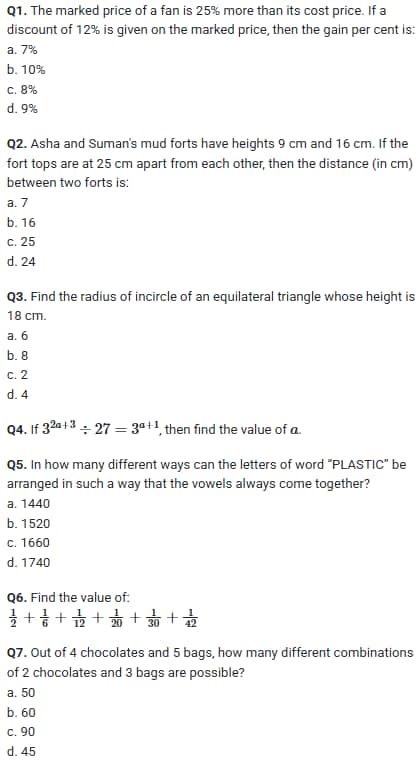
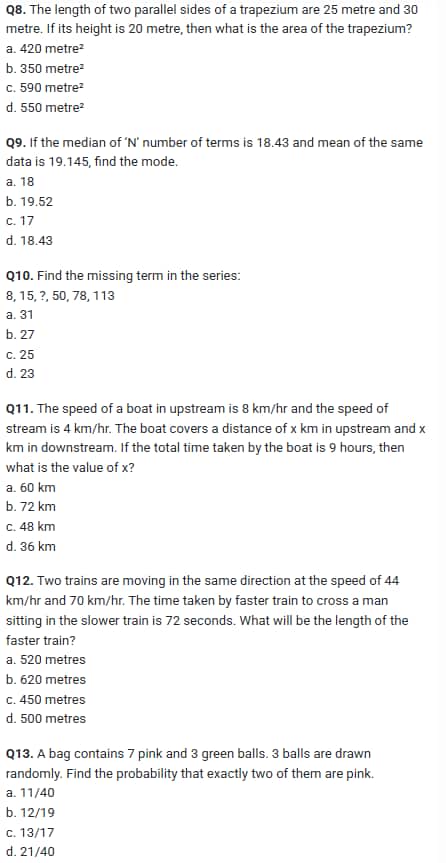
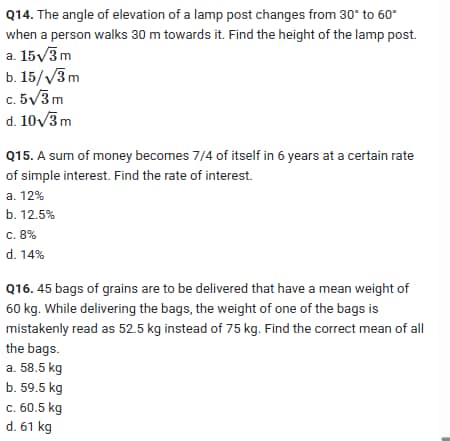
Q17: The first Indus Valley site excavated in India after independence is:
a. Ropar
b. Kalibangan
c. Banawali
d. Lothal
Q18: ‘SONAR’ is mostly used by -
a. Astronauts
b. Doctors
c. Engineers
d. Navigators
Q19: Parsec (PARSEC) is a unit of -
a. Distance
b. Time
c. Brightness of light
d. Magnetic force
Q20: Select the analogous pair to ‘Force : Newton’:
a. Internet : Email
b. Volume : Meter
c. Power : Unit
d. Current : Ampere
Q21: Leprosy is caused by -
a. Virus
b. Bacteria
c. Mycoplasma
d. Protozoa
Q22: Salk vaccine is related to which of the following diseases?
a. Smallpox
b. Tetanus
c. TB
d. Polio
Q23: The disease caused by inflammation of the membrane covering the brain and spinal cord is -
a. Leukemia
b. Paralysis
c. Sclerosis
d. Meningitis
Q24: Dengue fever is caused by the bite of which of the following mosquitoes?
a. Anopheles
b. Aedes
c. Culex
d. Asian tiger mosquito
Q25: What is the cause of ‘Minamata’ disease?
a. Chromium polluted water
b. Mercury polluted water
c. Lead polluted water
d. Fluoride polluted water
Q26: The causative agent of typhoid fever in humans is -
a. Fungus
b. Virus
c. Bacteria
d. Worm
Important Topics Covered in GAT CUET 2026
Students should focus on the following topics while preparing for the GAT section:
Quantitative Aptitude: Number systems, percentages, ratios, averages, profit & loss
Logical Reasoning: Series, coding-decoding, blood relations, syllogisms
Data Interpretation: Tables, bar graphs, pie charts, line graphs
General Mental Ability: Analogies, pattern recognition, spatial reasoning
Verbal Reasoning: Basic language-based reasoning questions
Frequently Asked Questions (FAQs)
Q: What is GAT in CUET 2026?
A:
GAT stands for General Aptitude Test. It is a section in CUET 2026 that tests students on quantitative ability, logical reasoning, and general mental aptitude. It is part of Section III of the CUET exam.
Q: How many questions are there in the GAT CUET 2026 paper?
A:
The GAT section in CUET 2026 has 50 questions in MCQ format, and all 50 questions are to be attempted.
Q: Is there negative marking in GAT CUET 2026?
A:
Yes, there is negative marking in GAT CUET 2026. You get +5 marks for every correct answer and lose -1 mark for every wrong answer. Unattempted questions carry 0 marks.
Q: Is the GAT CUET 2026 paper the same across all shifts?
A:
No, the question paper may differ across shifts and exam dates. However, the overall syllabus, pattern, and difficulty level remain consistent.
Q: Can I rely only on the GAT CUET 2026 question paper for preparation?
A:
The question paper is a great resource, but it should be used alongside the full syllabus, mock tests, and previous year papers for the best results.
Q: Where can I download the GAT CUET 2026 question paper with solutions?
A:
The PDF download link will be made available on this page shortly after the exam. Bookmark this page and check back after your exam date.
Articles
Related Stories
|
Upcoming University Exams

Certifications By Top Providers
Explore Top Universities Across Globe
Popular Courses and Specializations
Popular Degrees
Popular Branches
List of colleges accepting CUET UG
Questions related to CUET UG
On Question asked by student community
Have a question related to CUET UG ?
Hi!
Given below is the link to access the CUET 2027 English Vocabulary:
https://university.careers360.com/articles/cuet-2027-english-vocabulary-words
You may also find these helpful:
https://university.careers360.com/articles/50-most-important-phrasal-verbs-for-cuet-ug-2027
https://university.careers360.com/articles/idioms-and-phrases-for-cuet-2027-english-preparation
Hope that helps!
Hi student!
Given below are the links to access the CUET UG Previous Year Question Papers.
Also check:
https://university.careers360.com/articles/cuet-previous-year-question-papers
https://university.careers360.com/articles/cuet-ug-pyq
https://university.careers360.com/articles/cuet-question-papers
Hope it helps!
Hello Divyam,
Download CUET UG PCM memory-based papers from the link below and apply filters to access Physics, Chemistry, and Math resources.
https://www.careers360.com/download/cuet-ebooks-and-sample-papers
Hi,
You can check the CUET Tamil previous year question paper with answer key by clicking on the link below.
Hi,
The total marks of CUET UG for each subject is 250 marks. You can check the CUET OBC cut off marks of previous year by clicking on the link below.

Applications for Admissions are open.
Last Date to Apply: 17th August | QS I-Gauge Diamond Rated | NAAC A+ Accredited | 621 Recruitment Partners | INR 40 LPA Highest CTC | 4482 Job offers
SRM University, Chennai Science and Humanities 2026
ApplyNAAC A++ Accredited | Ranked #12 by NIRF
ICFAI Jharkhand B.A Admissions 2026
ApplyEducation World: Ranked 2nd in Jharkhand by Education World India Private Universities Ranking-2021
ICFAI Hyderabad BA Admissions 2026
ApplyMerit Scholarships | NAAC A+ Accredited | Top Recruiters: Nvidia, CISCO, Genpact, Amazon & many more
SRM University Ramapuram B.A Admissions 2026
ApplyApplication form FREE of Cost for a Limited Period of Time | #11 by NIRF | NAAC A++ Accredited Institution | 1100+ Recruiters
CUET UG Notifications
Never miss CUET UG update
Get timely CUET UG updates directly to your inbox. Stay informed!