Quantum University Admissions 2026
33.5 LPA-Highest Package | Up to 100% scholarship worth 30 CR


Students have noticed one other type of marks in their CUET scorecard 2026, other than their raw score, the percentile score. Naturally the question arises, what is it and how to calculate CUET percentile. NTA calculates CUET percentile by dividing the number of students who have scored equal or less than you in that particular session by the total number of students who appeared in that shift, then multiplying that number with 100.
Latest: CUET UG Result 2026 Out - Check Live Updates
This Story also Contains
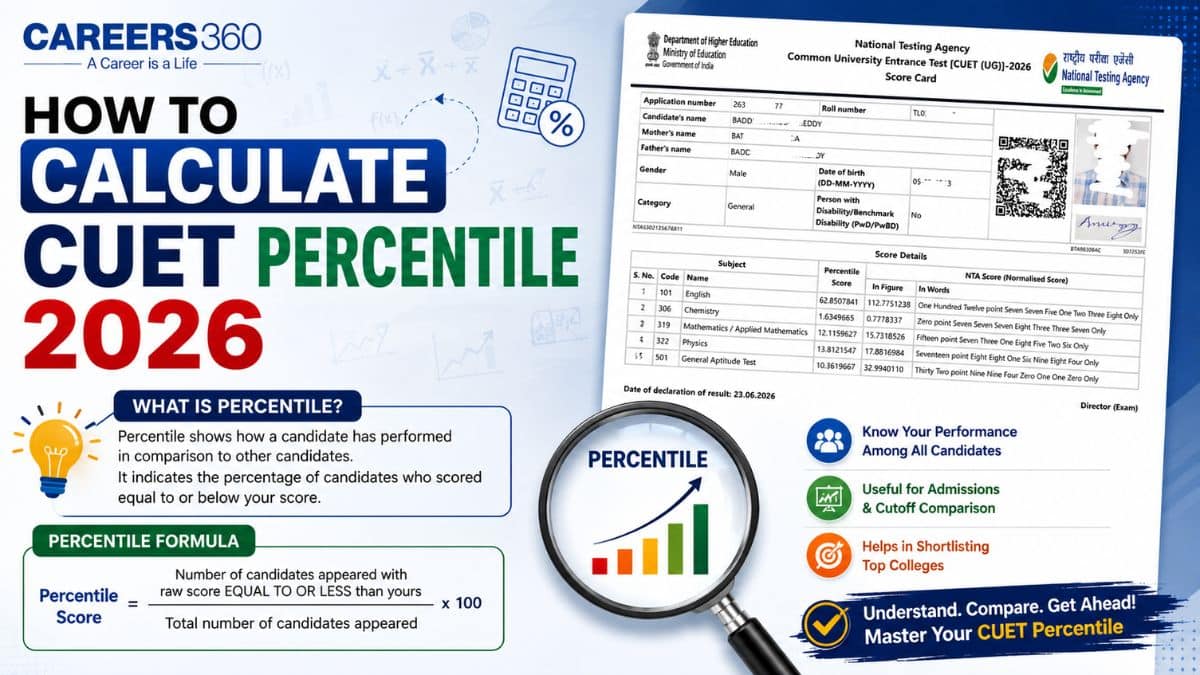
To put it simply, unlike your raw score, which mentions your exam score, the CUET percentile is how well you have performed in the exam as compared to others. For reference, a CUET score between 240 to 250 typically results in 99.8 to 100 CUET UG percentile, 230 to 239 score means 99.5 to 99.8 percentile, 220 to 229 means 98.5 to 99.5 percentile and so on.
The CUET Percentile Score means the percentage of candidates who have scored equal to or below (same or lower raw scores) in that particular exam shift. The CUET percentile score of a candidate in the subject is calculated as follows:
Also read,
33.5 LPA-Highest Package | Up to 100% scholarship worth 30 CR
Get expert advice on college selection, admission chances, and career path in a personalized counselling session.
NTA uses a specific formula to calculate CUET percentile scores. Based on the CUET percentile formula, here is how NTA calculates the scores:
CUET Percentile = Number of candidates appeared in the 'Shift' with raw score equal to or less than the candidate/ Total number of the candidates appeared in the 'Shift' * 100
CUET marks (Out of 250) | CUET Percentile |
|---|---|
240 to 250 | 99.8 to 100 percentile |
230 to 239 | 99.5 to 99.8 percentile |
220 to 229 | 98.5 to 99.5 percentile |
210 to 219 | 96 to 98.5 percentile |
200 to 209 | 93 to 96 percentile |
190 to 199 | 88 to 93 percentile |
180 to 189 | 82 to 88 percentile |
170 to 179 | 75 to 82 percentile |
160 to 169 | 68 to 75 percentile |
150 to 159 | 60 to 68 percentile |
140 to 149 | 52 to 60 percentile |
130 to 139 | 45 to 52 percentile |
120 to 129 | 38 to 45 percentile |
110 to 119 | 30 to 38 percentile |
100 to 109 | 22 to 30 percentile |
No, CUET percentile and normalised scores are not the same. While CUET percentile is a matrix which shows how many candidates who have outperformed, the normalised scores are a marking process used by NTA to maintain fairness on the exam process in case there are same subject exam conducted throughout multiple shifts.
Imagine, the history paper in CUET is conducted in three different shifts, on three different days. It is normal that one day’s question paper will be more difficult than the other. Will that be fair to students who attended the difficult paper shift? To tackle that, NTA has come up with a normalised score which gives the marks as per the paper difficulty, so that students from every shift get fair marking. Check the CUET normalisation process in detail here.

On Question asked by student community
Hi!
Given below is the link to access the CUET 2027 English Vocabulary:
https://university.careers360.com/articles/cuet-2027-english-vocabulary-words
You may also find these helpful:
https://university.careers360.com/articles/50-most-important-phrasal-verbs-for-cuet-ug-2027
https://university.careers360.com/articles/idioms-and-phrases-for-cuet-2027-english-preparation
Hope that helps!
Hi student!
Given below are the links to access the CUET UG Previous Year Question Papers.
Also check:
https://university.careers360.com/articles/cuet-previous-year-question-papers
https://university.careers360.com/articles/cuet-ug-pyq
https://university.careers360.com/articles/cuet-question-papers
Hope it helps!
Hello Divyam,
Download CUET UG PCM memory-based papers from the link below and apply filters to access Physics, Chemistry, and Math resources.
https://www.careers360.com/download/cuet-ebooks-and-sample-papers
Hi,
You can check the CUET Tamil previous year question paper with answer key by clicking on the link below.
Hi,
The total marks of CUET UG for each subject is 250 marks. You can check the CUET OBC cut off marks of previous year by clicking on the link below.

NAAC A++ Accredited | Ranked #12 by NIRF
Education World: Ranked 2nd in Jharkhand by Education World India Private Universities Ranking-2021
Merit Scholarships | NAAC A+ Accredited | Top Recruiters: Nvidia, CISCO, Genpact, Amazon & many more
Application form FREE of Cost for a Limited Period of Time | #11 by NIRF | NAAC A++ Accredited Institution | 1100+ Recruiters