Management Development Institute, Gurgaon
Top B-School: Ranked #9 in NIRF Management Rankings 2025.


Delhi’s air pollution continues to dominate national concern. It is no secret that the burning of agricultural residue in surrounding states like Punjab and Haryana is a major contributor. The resulting smoke and pollutants are carried towards Delhi by north-westerly winds, worsening the city’s air quality. The challenge of crop residue burning reveals a deeper, more complex reality, sitting at the intersection of environment, economy, human behaviour, and technology.
Locally, it directly deteriorates the respiratory health of populations. Red eyes, itchiness, and increased susceptibility to cough are immediate health implications of the crisis. Socially, the effects are just as severe. Many farmers report that their children are often unable to attend school in the mornings due to dense fog and poor visibility. Life expectancy, too, is reduced among populations living in these conditions.
Also See: Ahmedabad University Admissions
While sustainable alternatives exist, their adoption remains limited due to affordability constraints, lack of awareness, and uncertainty about outcomes. Addressing such layered problems requires interdisciplinary thinking, examining real-world challenges through multiple lenses and combining data, field insights, and behavioural understanding. The work led by Professor Subhankar Saha from the Amrut Mody School of Management exemplifies this approach. Professor Saha’s study identifies the economic, technological, and institutional barriers that farmers face and responds with a multi-stakeholder intervention designed for practical adoption.
Although alternatives to crop residue burning are available, they require access to specialised machinery that most farmers cannot afford, particularly since these machines are needed for only a few days each year. Even with government subsidies in place, the challenges persist. Farmers often lack the technical know-how to operate these machines and remain uncertain about the outcomes. Given that crop yield is their primary source of livelihood, they are hesitant to shift from conventional practices without clear evidence of benefits, such as yield data. Concerns about machine breakdowns and operational risks further add to the hesitation.
Also See: Ahmedabad University
The intervention introduced a multi-stakeholder, ground-level support system that complemented existing government schemes. It included personalised assistance from trained village volunteers who worked directly with farmers to resolve practical field challenges. This was further strengthened through interpersonal and community-level efforts. Experienced farmers were brought in to share their knowledge through demonstration videos, helping build trust and familiarity with the machinery.
Awareness initiatives were also conducted in local schools, encouraging children to influence household practices. At the community level, shared “tool banks” were established, allowing farmers to rent machinery rather than purchase it individually. The intervention brought together multiple stakeholders, creating a collaborative ecosystem to support behavioural change.
Using satellite-based fire-detection data, census demographics, and primary farmer survey data, the intervention indicated positive environmental and economic benefits for farmers. A key indicator was the reduction in fire incidents, tracked using satellite-based data. The results showed a statistically significant decline in the number of fires in intervention areas, indicating a shift away from crop residue burning towards more sustainable practices. Additionally, farmers who adopted sustainable practices reported higher crop yields than those who continued with conventional methods.
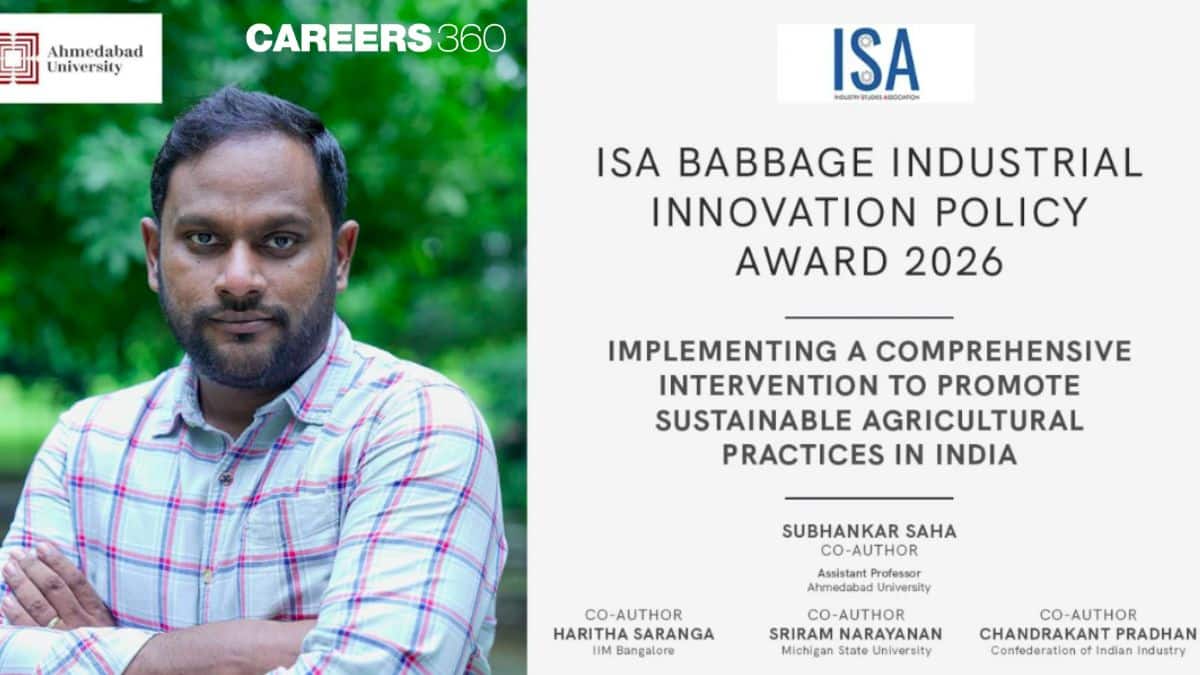
Professor Saha’s study, titled “Implementing a Comprehensive Intervention to Promote Sustainable Agricultural Practices in India,” has won the ISA Babbage Industrial Innovation Policy Award 2026 from the Industry Studies Association. Conducted in collaboration with Professor Haritha Saranga (IIM Bangalore), Professor Sriram Narayanan (Michigan State University), and Chandrakant Pradhan (Confederation of Indian Industry), the study is based on one of the chapters of Professor Saha’s doctoral thesis.
Disclaimer: This content was distributed by Ahmedabad University and has been published as part of Careers360’s marketing initiative.

On Question asked by student community
Read the information below -
Ahmedabad University is a private, non-profit university in Gujarat, India, set up in 2009 by the Ahmedabad Education Society.
It comprises three schools and five centres with opportunities for interdisciplinary scholarship.
Based on previous year cutoffs, you can get the idea of this year cutoffs.
Hi,
For B.Tech , candidates have to appear and qualify the Joint Entrance Examination (JEE Main) /Gujarat Common Entrance Test ( GUJCET ).
Hi there,
Since you want admission is SEAS ahmedabad university, you have to clear gujcet to get admission that college.
And according to last year cutt off in ews category your rank should be around
1) 12k for mechanical
2) 14k for chemical
I hope this help
Regards
Hello aspirant,
Yes, you can definitely get ahmedabad university as for that you must have cleared jee mains and have physics , chemistry, mathematics and english in your 12th as subjects. 50% aggregate of marks in 12th.
For more info click on the given link below.
https://www.careers360.com/university/ahmedabad-university-ahmedabad

Top B-School: Ranked #9 in NIRF Management Rankings 2025.
NAAC A-Grade | UGC Autonomous
Highest CTC- 21 LPA | Average CTC- 10.38 LPA | Scholarships Available
Leading Design College | 95% Placement Record | Merit-cum-Means Scholarships for Deserving Students
Highest CTC 20.56 LPA | Average CTC 11.4 LPA | 250+ Recruiters | 2nd Position in Pune.
Grade 'A+' accredited by NAAC