
Search Colleges, Exams, Schools & more


Login
How Positrons "Lock" onto Molecules Before Annihilation, A Study by Prof. Soumen Ghosh, Ahmedabad University
Research led by Ahmedabad University Professor Soumen Ghosh and alumnus Akhil Mundaplackal reveals that complex molecular vibrations—not just simple ones—trap antimatter particles (positrons). Published in Physical Review A, this study, conducted with UC San Diego, provides new evidence on how positrons "lock" onto molecules before annihilation. Read more about this research in the full article shared by Ahmedabad University.
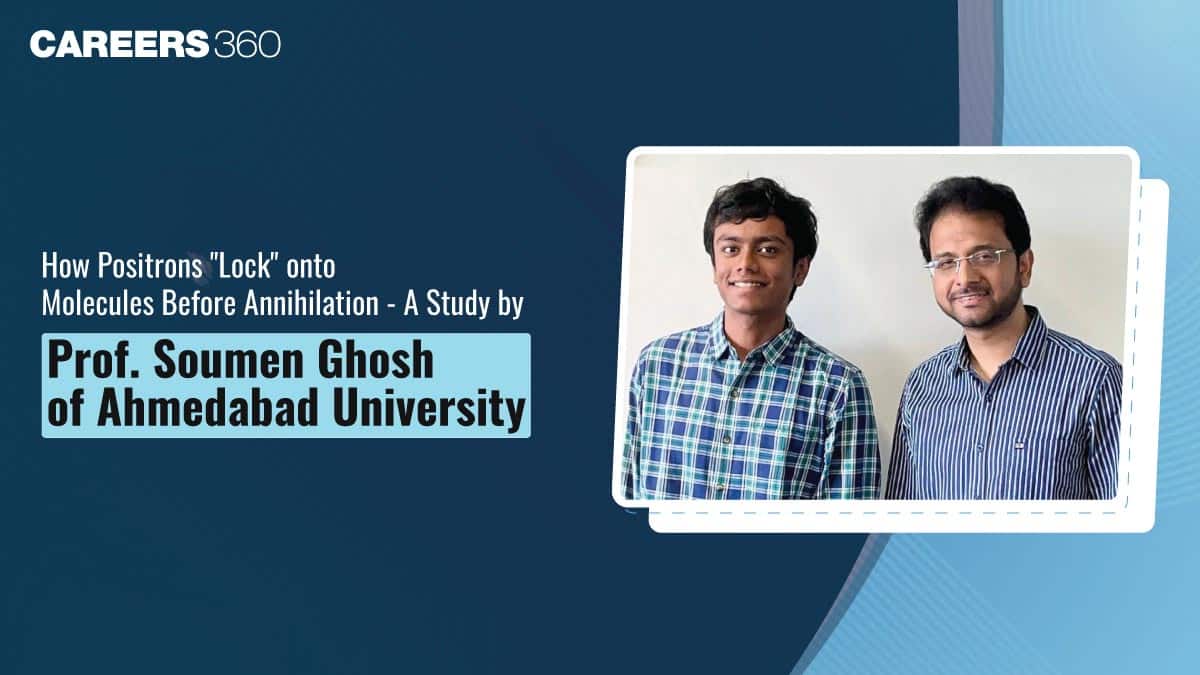
Complex molecular vibrations facilitate the trapping of antimatter particles, enabling distinct binding states that momentarily hold a positron to a molecule before it annihilates. This finding comes from research led by Professor Soumen Ghosh from the School of Arts and Sciences and Ahmedabad University alumnus Akhil Mundaplackal, who contributed to the study as part of his undergraduate thesis. The work involved collaboration with researchers at UC San Diego.
Also See: Ahmedabad University Admissions
The research challenges long-standing theoretical assumptions that positron binding occurs primarily through simple, single molecular vibrations. While earlier models acknowledged the presence of multi-quantum vibrations, they assumed they would only contribute to a blurry, continuous background.
When a positron, the antimatter counterpart of an electron, interacts with a molecule, it can be captured into a transient bound state before annihilating. However, the mechanism by which a positron initially "locks" onto the molecule has remained an open question. For decades, standard models suggested that simple vibrations were the primary drivers of this process. However, high-resolution positron beam experiments proved otherwise, demonstrating that positron coupling with multi-quantum vibrations creates discrete, sharp, well-defined capture points.
Titled “Positron–molecule annihilation resonances beyond the fundamental vibrations”, the study has been accepted for publication in Physical Review A, a leading peer-reviewed scientific journal. It provides evidence that complex molecular motions are not merely background effects but play an active role in antimatter interactions.
Disclaimer: This content was distributed by Ahmedabad University and has been published as part of Careers360’s marketing initiative.
Articles
Upcoming University Exams

Certifications By Top Providers
Explore Top Universities Across Globe
List of Related colleges
Questions related to Ahmedabad University
On Question asked by student community
Have a question related to Ahmedabad University ?
Read the information below -
Ahmedabad University is a private, non-profit university in Gujarat, India, set up in 2009 by the Ahmedabad Education Society.
It comprises three schools and five centres with opportunities for interdisciplinary scholarship.
Based on previous year cutoffs, you can get the idea of this year cutoffs.
Hi,
For B.Tech , candidates have to appear and qualify the Joint Entrance Examination (JEE Main) /Gujarat Common Entrance Test ( GUJCET ).
- Eligible candidates have to fill an application form available on the website of AU.
- 50% of seats will be directly filled on the basis of the marks
Hi there,
Since you want admission is SEAS ahmedabad university, you have to clear gujcet to get admission that college.
And according to last year cutt off in ews category your rank should be around
1) 12k for mechanical
2) 14k for chemical
I hope this help
Regards
Hello,
Eligibility for BCom is passed 10+2 from a recognized board, candidates belonging to both science stream/commerce stream are.eligible to apply for this course. Admission is done based on the entrance test UGAT, final selection is done on UGAT score followed by counselling by the university.
Eligibility for BCom is passed 10+2 from a recognized board, candidates belonging to both science stream/commerce stream are.eligible to apply for this course. Admission is done based on the entrance test UGAT, final selection is done on UGAT score followed by counselling by the university.
Hello aspirant,
Yes, you can definitely get ahmedabad university as for that you must have cleared jee mains and have physics , chemistry, mathematics and english in your 12th as subjects. 50% aggregate of marks in 12th.
For more info click on the given link below.
https://www.careers360.com/university/ahmedabad-university-ahmedabad

Applications for Admissions are open.
Ranked #45 Among Universities in India by NIRF | Get Upto 100% Scholarships | Spot Admissions via CUET
Woxsen University B.Tech Admissions 2027
ApplyIIRF Top Private Engineering College 2026: All India Rank #13 | H-CTC 18 LPA | Merit-Based Scholarships
GMRIT Deemed to be Univ B.com (Comp Application) 2026
Apply100+ Recruiters | 100+ Placements of 2026 Batch | NBA & NAAC Accredited | Highest CTC 37 LPA
Atlas SkillTech University | B.Tech Admissions
ApplyCourses designed with CTOs, Data Scientists, and Cybersecurity experts | 50+ elective options
IIFM- Indian Institute of Forest Management Admissions 2027
ApplyHighest CTC- 21 LPA | Average CTC- 10.38 LPA Scholarships Available | MBA in Forestry Management MBA in Sustainability Management MBA in Sustainable Development MBA in Development and Sustainable Finance