Management Development Institute, Gurgaon
Top B-School: Ranked #9 in NIRF Management Rankings 2025.


KIET Deemed to be University, Delhi-NCR, Ghaziabad, inaugurated the 6th International Conference on Emerging VLSI and Semiconductor Technology for AI and Computing Applications (EVST-2026) on Friday, 26 June 2026. Organised by the Department of Electronics and Communication Engineering, the two-day international conference brought together eminent scientists, academicians, researchers, policymakers, industry leaders, and students from across India and abroad to deliberate on emerging trends in Artificial Intelligence, VLSI design, semiconductor technologies, embedded systems, and next-generation computing.
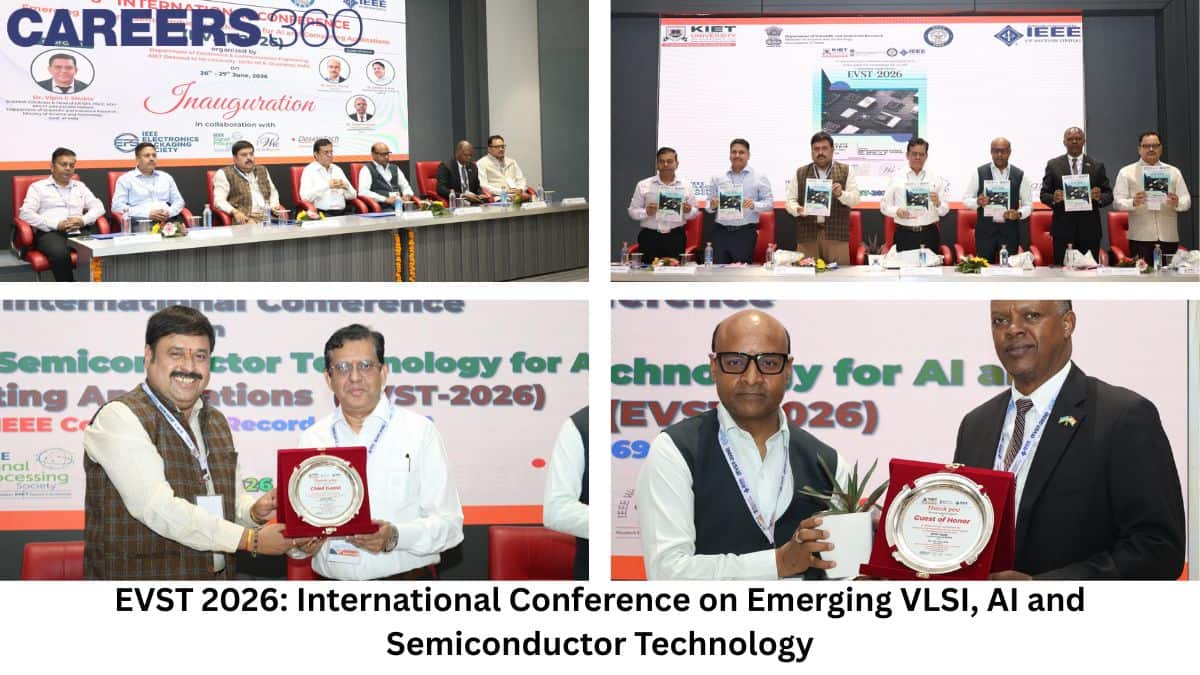
Receiving over 1,400 research paper submissions from premier institutions worldwide, EVST-2026 maintained its global academic excellence by selecting only 166 papers through a rigorous peer-review process, resulting in a highly competitive 11.4% acceptance rate. The conference attracted participants from countries including the United States, Uzbekistan, and India, while researchers and delegates from more than 14 Indian states participated, making EVST-2026 a vibrant platform for international academic collaboration.
Also See: KIET Deemed to be University Ghaziabad Admission
The conference is technically co-sponsored by the IEEE Uttar Pradesh Section and financially supported by the Department of Scientific and Industrial Research (DSIR), Government of India; the Defence Research and Development Organisation (DRDO), Government of India; and DesignTech Systems. The event aligns with the objectives of the India Semiconductor Mission and the vision of Viksit Bharat @2047, promoting innovation and research in semiconductor technologies and Artificial Intelligence.
The inaugural ceremony commenced with the traditional lamp lighting and Saraswati Vandana in the presence of distinguished dignitaries. Dr Vipin Chandra Shukla, Scientist-G & Adviser, Department of Scientific and Industrial Research (DSIR), Ministry of Science & Technology, Government of India, graced the occasion as the Chief Guest. The event was further enriched by the presence of Dr Sanjeev Kumar, Lead Education Application Engineer, Cadence Design Systems, and Mr Emile Mwepesi, Second Counsellor, High Commission of the Republic of Rwanda to India, as the Guests of Honour.
The programme was presided over by Prof. Nagraj Ramrao, Vice-Chancellor - KIET, along with Dr Manoj Goel, Pro Vice-Chancellor - KIET, and Dr Adesh Kumar Pandey, Director Academics, KIET.
In the presidential address, Prof. Nagaraj Ramarao emphasised the growing importance of Electronics and Communication Engineering professionals in today's interdisciplinary technological landscape, highlighting the tremendous advancements taking place in VLSI hardware, semiconductor chip design, and AI-driven computing. Congratulating all participating researchers for their valuable contributions, he encouraged them to actively engage with the keynote sessions and technical discussions, urging them to gain maximum insights from the distinguished experts to further enrich their research and innovation journey.
Also See: KIET Deemed to be University Placement
Dr. Vibhav Kr. Sachan, General Chair of EVST-2026, welcomed the delegates and presented an overview of the conference, highlighting its global reach and technical excellence. The inaugural session also witnessed the formal release of the EVST-2026 Conference Souvenir.
Addressing the gathering, Dr Sanjeev Kumar, Lead Education Application Engineer at Cadence Design Systems, shared valuable insights into the rapidly evolving semiconductor ecosystem and highlighted the convergence of VLSI, computing, Artificial Intelligence, and the Internet of Things (IoT) as the driving force behind next-generation intelligent electronic systems. He emphasised the importance of stronger industry-academia collaboration for developing future-ready talent capable of meeting the demands of the global semiconductor industry.
Speaking on the occasion, Mr Emile Mwepesi, Second Counsellor, High Commission of the Republic of Rwanda to India, appreciated KIET Ghaziabad's initiative in organising an international conference that provides an excellent platform for researchers, academicians, and industry professionals to exchange ideas and foster global collaborations.
Delivering the inaugural address, Dr Vipin Chandra Shukla encouraged researchers to ignite their minds through innovation and curiosity-driven research. He remarked that conferences of this stature broaden one's thinking, provide opportunities to build meaningful professional networks, and inspire collaborative research. Stressing that academia is the best platform for innovation and entrepreneurship, he highlighted the growing significance of start-ups in transforming research into technologies that contribute to national development and technological self-reliance.
The inaugural keynote address was delivered by Dr Neeta Pandey, Professor, Delhi Technological University (DTU), on "Fractional Domain Shadow Filtering: Opportunities, Challenges, and Applications." During her lecture, she introduced the audience to different types of filters used in modern signal processing before elaborating on the concept and applications of shadow filters. She further explained the emerging role of fractional domain filters in advancing intelligent signal processing and communication systems, while highlighting the associated research opportunities and challenges. During the session, Dr Neeta Pandey also inaugurated the IEEE Women in Engineering (WIE) Student Chapter at KIET, marking a significant milestone in promoting diversity, inclusion, and women’s leadership in engineering and technology.
The afternoon technical programme featured two distinguished keynote lectures. Mr Saurabh Tiwari, Senior Principal Engineer at Intel India, delivered an insightful address on "From Silicon to Intelligence: Enabling Next-Generation AI Systems through Architectural Innovation," highlighting the future of AI hardware, semiconductor architectures, and next-generation computing platforms. This was followed by Prof. Lalit Garg from the University of Malta, who presented an engaging lecture on "Building the Future of Digital Healthcare: AI, Blockchain, and Data-Driven Intelligence," emphasising the transformative role of Artificial Intelligence, blockchain technologies, and data-driven decision-making in revolutionising global healthcare systems.
Day One also witnessed the successful conduct of twelve parallel technical sessions across six major conference tracks, namely Emerging Materials and Device Technologies; IoT & Embedded Systems Design; VLSI Circuit and SoC Design; Packaging and Manufacturing; Electronics Design Automation, Testing & Verification; and the Role of AI/ML in Emerging Technologies. More than 90 research papers were presented by researchers from premier academic institutions and industries, leading to vibrant technical discussions, collaborative interactions, and meaningful knowledge exchange.
The conference brought together over 180 delegates, including scientists, faculty members, industry experts, research scholars, and students, providing a unique platform for collaboration among academia, industry, and government organisations while fostering innovation in semiconductor and AI research.
The first day concluded on a highly successful note, setting the stage for another exciting day of keynote lectures, technical sessions, paper presentations, and the Valedictory Ceremony scheduled for 27 June 2026. EVST-2026 continues to reinforce KIET Deemed to be University's commitment to advancing research excellence, innovation, and global academic engagement while contributing significantly to India's rapidly evolving semiconductor and Artificial Intelligence ecosystem.
Disclaimer: This article has been published as a marketing collaboration between Careers360 and KIET Deemed to be University.

On Question asked by student community
Hi,
Kakinada Institute of Engineering and Technology (KIET), Korangi is a private engineering college affiliated with JNTU Kakinada. The total B.Tech tuition fee generally ranges from around Rs.1.4 lakh to Rs.2.1 lakh for the complete course, depending on the specialization and admission category.
For students admitted through AP EAMCET (Category
Hello Dear Student,
Kakinada Institute of Engineering and Technology (KIET), Korangi, is affiliated with JNTU Kakinada and offers various B.Tech programmes, including Computer Science and IT-related branches.
Total B.Tech tuition fee generally ranges from around Rs 1.4 lakh to Rs 2.1 lakh for the entire course.
The institute offers placement
Hi,
Among KIET, UPES, and Chandigarh University, Chandigarh University is considered a strong choice for BTech in CSE. It has a good placement record and excellent facilities compared to the others. Detailed information about Chandigarh University can be found in the link below.
Link: https://www.careers360.com/university/chandigarh-university-chandigarh/placement
Dear student,
Yes, you can use your EWS category rank for admission to KIET Ghaziabad through UPTAC counselling , as seats are allotted based on category ranks for reserved candidates.
Now, about your chances:
With an
EWS rank of 1,30,638
, getting
ECE at KIET
is
highly unlikely
. In
KIET Ghaziabad and JIIT Noida are both good private engineering colleges. But JIIT Noida is a little better in terms of placements, especially for Computer Science and IT branches.
JIIT Noida gets more big companies like Amazon, Adobe, and other product-based companies. The average package in JIIT for CSE is

Top B-School: Ranked #9 in NIRF Management Rankings 2025.
NAAC A-Grade | UGC Autonomous
Highest CTC- 21 LPA | Average CTC- 10.38 LPA | Scholarships Available
Highest CTC 20.56 LPA | Average CTC 11.4 LPA | 250+ Recruiters | 2nd Position in Pune.
Grade 'A+' accredited by NAAC
Top B School in South | Pre-Placement Offers | Higher Stipends