
Search Colleges, Exams, Schools & more


Login
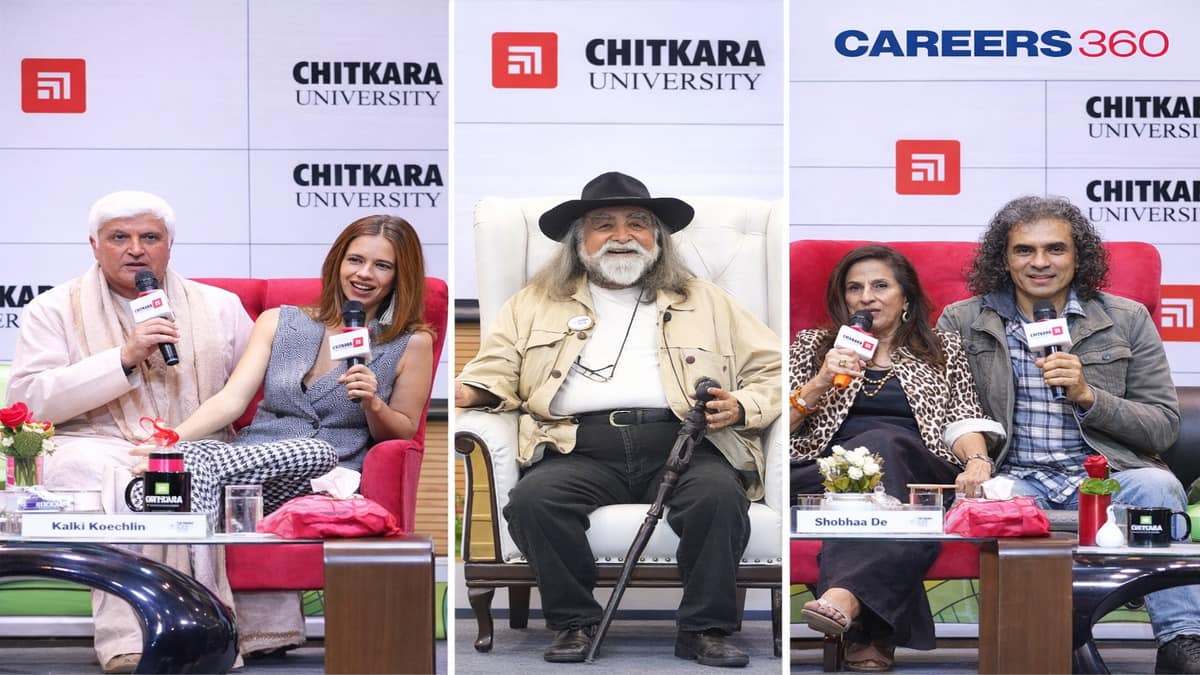
Chitkara University Hosts Fourth Edition of Chitkara Lit Fest on February 21
There is a deal that Indian students and their families have understood for generations: go to university, acquire a skill, and emerge employable. It is a reasonable deal. It has lifted millions into the middle class. But somewhere in its dominance, something got quietly lost — the idea that a campus might also be a place where you encounter a poet who changes how you read the world, or a filmmaker who makes you question what you thought you already knew about storytelling.
This Story also Contains
- The Festival Precedent
- What the Chitkara Lit Fest Has Been Building
- Why This Matters Beyond the Event
- A Different Kind of University
- About Chitkara University
That idea is coming back.
Read More: Chitkara University Admissions
The Festival Precedent
To understand what is happening on Indian campuses today, it helps to look at what happened off them first. The Jaipur Literature Festival — which began modestly in 2006 and grew into one of the world's largest free literary events — demonstrated something counterintuitive: that hundreds of thousands of people would travel to sit in the cold and listen to writers talk about books. The Dehradun Literature Festival proved that this appetite existed far beyond the metropolitan centres. The Kalinga Literary Festival, celebrating regional literatures alongside global voices in Bhubaneswar, showed that the demand was also for depth — for conversations about identity and language and the stories that particular places produce.
What these events established, collectively, is that the literary festival format works not because it is glamorous but because it is direct. A writer on stage is a person on stage. The distance between the person who made something and the person encountering it collapses. Questions get real answers. Ideas move.
University administrators noticed. And a few began asking whether a campus — with thousands of young people gathered in one place at precisely the moment they are forming opinions about everything — might be the most natural home for this kind of encounter yet.
What the Chitkara Lit Fest Has Been Building
Chitkara University's answer has been the Chitkara Lit Fest, which recently concluded its fourth edition. It would be accurate to call it a campus literary festival; it would also miss the point slightly. From the beginning, the ambition has been to create something that functions like the better public festivals — where the conversation is the thing, not the credentials of whoever is having it.
The inaugural edition in 2023 carried the uncertainty of any first attempt, but the intent was clear. Javed Akhtar, Irshad Kamil, Usha Uthup — not decorative appearances but genuine engagements. Students who had encountered these figures only through cinema, music, or textbooks found themselves in the same room, listening to them talk about failure and discipline and the long years before anything they made felt good enough. That kind of conversation doesn't translate to a recording. You had to be there.
Subsequent editions brought in filmmakers, journalists, and cultural commentators alongside writers and poets — a deliberate choice, because the boundaries between these forms have been dissolving for years. A novelist now needs to think about adaptation. A journalist works across text, audio, and video. A documentary filmmaker is often doing the work a literary non-fiction writer used to do alone. The festival reflected that reality rather than pretending the old categories still hold.
By the third edition — with voices like Shobhaa De, Kalki Koechlin, Lisa Ray, and Neelesh Misra — the conversations had moved into territory that rarely gets covered in a lecture hall: what reinvention actually costs, what it takes to build a public life that doesn't follow anyone else's blueprint, how identity and work and creativity tangle together in ways that career counselling doesn't begin to address.
The fourth edition reflected a quieter confidence. Less emphasis on scale, more on the quality of exchange — engineering students in conversations about poetry, management students sitting with philosophical questions, design students being asked to think about social narratives that had nothing directly to do with their coursework and everything to do with the world they will practise their craft in.
Read More: Chitkara University Placements
Why This Matters Beyond the Event
Something specific happens when a student asks a real question and receives a real answer from someone whose work they have actually cared about. They begin to see themselves differently — not just as recipients of knowledge moving toward a qualification, but as people with their own ideas worth developing. Many discover for the first time that they want to write, or perform, or argue a position in public. The open-mic sessions and hallway conversations after panels often leave a more lasting impression than the formal programmes.
There is also a practical argument, and it is worth making plainly. The skills that literary and cultural engagement builds — comfort with complexity, the ability to listen carefully and communicate clearly, the habit of sitting with ambiguity rather than reaching for the nearest available answer — are increasingly what employers report they cannot find, and what artificial intelligence is least likely to replicate. Technical competence gets a graduate through the door. These qualities determine what happens once they are inside.
A Different Kind of University
What the Chitkara Lit Fest represents, and what a broader shift across Indian higher education is beginning to represent, is a renegotiation of what a campus is for. The best literary festivals — whether they have been running for two decades in Jaipur or four years on a university campus in Punjab — create the same conditions. A space where ideas are taken seriously. Where the person in the audience asking a question matters as much as the person on stage answering it. Where an encounter with a different perspective can, if you let it, genuinely change how you see things.
Universities that invest in building those spaces — not as marketing exercises but as a genuine commitment to intellectual life — are making a long bet. The bet is that education is about more than producing employable graduates, and that the two goals are not actually in competition. A student who has been intellectually alive on campus is more adaptable, more curious, and more capable of working through problems that do not have textbook answers. Skilled graduates are necessary. Ones who also know how to think are rarer, and the world has considerably more use for them than it has historically been willing to admit.
About Chitkara University
Chitkara University is a UGC-recognised and NAAC-accredited private university in North India, with campuses in Punjab and Himachal Pradesh, offering career-oriented undergraduate and postgraduate programs in Engineering, Business, Healthcare, Pharmacy, Design, Architecture, Hospitality, and emerging technology fields. For students planning higher education, the University provides industry-aligned programs designed to combine academic excellence with practical exposure.
The curriculum at Chitkara University emphasises experiential learning through internships, industry projects, research opportunities, and global collaborations, supported by modern infrastructure, advanced laboratories, industry mentorship, and skill-based training that strengthens student employability. Backed by 2,000+ campus recruiters and 300+ international academic and industry collaborations, students gain strong placement support, international exposure, academic exchange, and collaborative research opportunities.
Consistently ranked among leading institutions by national and global frameworks such as NIRF, QS World University Rankings, and Times Higher Education, the University maintains high academic rigour and industry relevance. With strong corporate partnerships and a focus on innovation, entrepreneurship, and interdisciplinary learning, it prepares students for emerging career opportunities in India and abroad.
Disclaimer: The above piece of content has been distributed by Chitkara University, and published as part of the marketing initiative with Careers360.
Articles
Upcoming University Exams
Certifications By Top Providers
Explore Top Universities Across Globe
List of Related colleges

Questions related to Chitkara University
On Question asked by student community
Have a question related to Chitkara University ?
For Pharm D students at Chitkara University, having a laptop can be highly useful for coursework, assignments, and research. Many aspects of modern academic studies involve digital resources, online research, and software tools that are easier to manage with a laptop. While it might not be mandatory for all tasks,
Hello,
Based on the information provided, you have secured 67% in your board examinations and a score of 49.9 in JEE Mains. Chitkara University, Punjab, requires candidates to have passed their 10+2 examination with a minimum aggregate of 60% or at least 60% in Physics, Chemistry, and Mathematics. Additionally, appearing
Chandigarh University:
Civil Engineering
Fees: INR 7.08 lakhs for 4 years
Seats: 240 seats
Eligibility Criteria : 10+2 with Physics and Mathematics as compulsory subjects along with one of the following subjects: Chemistry / Biotechnology / Computer Science / Biology with at least 50% marks in the aggregate.
Placement percentage
Hello,
For its Rajpura Campus, Chitkara University is more known. When something is called renowned, it implies that there is greater flexibility in terms of locations. The Rajpura campus has supplanted the Baddi campus as the centre for engineering studies. The instructors, coursework, and extracurricular activities are great. Regarding placements,
I think you should go for LPU for interior designing. LPU is the best choice for B.Designing where the students get tons of career opportunities. Because of quality education and world-class placements, LPU has marked its place in top 74th Global Universities.
Let me highlight some of the major factors

Applications for Admissions are open.
Top B-School: Ranked #9 in NIRF Management Rankings 2025.
International Institute of Business Studies, Bangalore
ApplyNAAC A-Grade | UGC Autonomous
International School of Management Excellence, Bangalore
ApplyTop B School in South | Pre-Placement Offers | Higher Stipends
Woxsen University, Hyderabad
ApplyUG & PG Scholars’ Round Deadline: 14th Nov’26 | Earn upto 50% merit Scholarship + 10% for top performers | EFMD Accredited | AACSB (USA) & AMDISA Member | Highest CTC 28 LPA
Symbiosis School for Liberal Arts, Pune
ApplyAdmissions open for 4 year full time B.A/B.Sc Liberal Arts & B.A/B.Sc (Liberal Arts) Honours with Research
Dr Vishwanath Karad MIT World Peace University, Pune
ApplyHighest CTC 30 LPA | #9 in Management Category by Times B-School | Merit-Based Scholarship Upto - 50 Crores