School of Liberal Studies and Humanities, UPES Dehradun
Ranked #45 Among Universities in India by NIRF | Get Upto 100% Scholarships


CUET Mathematics Question Paper 2026: The National Testing Agency (NTA) has finally wrapped up the CUET UG 2026 Mathematics examination, it was conducted across several shifts during the exam window. Now candidates can go ahead and check the CUET Mathematics memory based questions along with a shift-wise exam analysis that you can find on this page. The content here usually covers the overall difficulty level, the key chapters that were asked, the question pattern, plus little student reactions from different shifts, so you kinda get the vibe of how it went. From the student feedback and the expert review, the overall difficulty level of the CUET UG 2026 Mathematics paper was moderate to difficult. The question set had a blend of formula-based problems, concept-led questions, and some calculation-heavy parts drawn from the major syllabus topics. The question paper will be provided shortly once it is released by NTA. A lot of students said the exam felt doable but also time-consuming, and honestly the outcome mostly leaned on how fast someone could work, how accurate the steps were, and how solid their conceptual clarity really is.
This Story also Contains
Candidates looking for detailed Exam Analysis can download: Maths CUET 2026 Exam Analysis and Memory-Based Questions
| Date | Shift 1 Analysis | Shift 2 Analysis |
|---|---|---|
| 12 May | - | Moderate but lengthy - Calculus tougher; time management important |
| 14 May | - | Moderate - concept-driven with strong Calculus weightage |
| 15 May | Moderate - lengthy paper with Calculus highest weightage | - |
| 18 May | Easy to Moderate - lengthy but manageable; formula-based | - |
| 19 May | Easy to Moderate - lengthy with strong Calculus and Matrices focus | Moderate - concept-heavy and lengthy |
| 20 May | Moderate to Difficult - Probability and Calculus dominant | - |
| 21 May | Moderate - Matrices & Integrals high weightage; some tricky questions | Easy to Moderate - balanced and manageable |
| 22 May | - | Moderate to Difficult - lengthy with heavy calculations |
| 25 May | Moderate - slightly lengthy with mixed difficulty | - |
| 26 May | Moderate to Difficult - lengthy, tricky, and calculation-heavy | - |
| Parameter | Observation |
|---|---|
| Easiest Shift | 18 May Shift 1 |
| Toughest Shift | 26 May |
| Lengthiest Shift | 22 May Shift 2 / 26 May |
| Most Calculus-Heavy | 15 May Shift 1, 20 May Shift 1, 22 May Shift 2 |
| Most Matrix-Focused | 21 May Shift 1, 26 May |
| Most Probability-Focused | 20 May Shift 1 |
| Most PYQ-Based Shift | 19 May Shift 2 |
| Section | Overall Trend |
|---|---|
| Calculus | Highest weightage in almost every shift |
| Matrices & Determinants | Frequently asked with multiple questions |
| Probability | Consistent presence across shifts |
| Vectors & 3D Geometry | Moderate weightage |
| Differential Equations | Strong recurring topic |
| Linear Programming | Mostly direct and figure-based |
Below is the detailed analysis of the CUET Maths 2026 Question Paper.
The Mathematics paper was moderate to difficult in difficulty level.
It was considered lengthy and tricky by many students.
The paper required strong conceptual clarity along with fast calculation speed.
Matrices & Determinants had high weightage with multiple questions.
Questions were asked from Definite Integrals, Differential Equations, and Application of Derivatives.
Probability was an important topic, especially questions based on independent events and Bayes’ theorem.
Vectors & 3D Geometry also had noticeable weightage.
The main challenge in Maths was managing time due to lengthy calculations.
Overall Maths paper was moderate to slightly lengthy.
The Mathematics paper was divided into 3 sections - 35, 35 and 15 questions.
Students had to attempt one section of 35 questions along with the 15-question section.
The paper included a mix of direct formula-based and calculation-oriented questions.
Questions required both concept clarity and speed, especially in calculation-heavy parts.
Some questions were straightforward, but a few required longer solving.
Time management was important because of the paper structure and mandatory section selection.
Students with strong formula revision and regular practice found the paper manageable.
Ranked #45 Among Universities in India by NIRF | Get Upto 100% Scholarships
Application form FREE of Cost for a Limited Period of Time | #11 by NIRF | NAAC A++ Accredited Institution | 1100+ Recruiters
The overall difficulty level of the Mathematics paper was between moderate to difficult.
Students found the paper quite lengthy, with many questions involving extensive calculations and step-by-step solving.
A significant number of questions were asked from Definite Integrals, making Calculus one of the dominant sections in the paper.
Vectors and 3D Geometry had strong weightage, with multiple conceptual as well as calculation-based questions appearing in the shift.
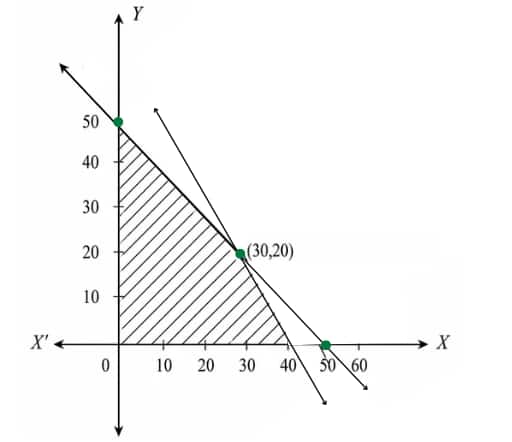
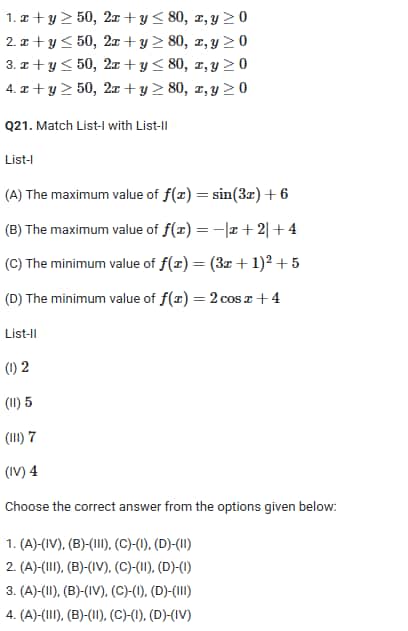
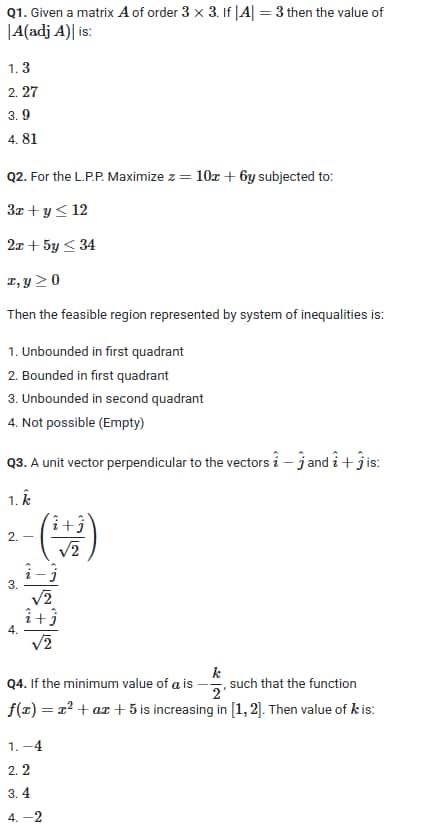
Linear Programming Problems (LPP) also contributed several questions, mostly based on graphical interpretation and optimization concepts.
Relation and Functions had around 1-2 questions, mainly formula and property-based.
Inverse Trigonometric Functions (ITF) also had 1-2 questions, testing identities and standard results.
The paper focused more on problem-solving speed and accuracy rather than direct formula-based questions.
Many aspirants reported that time management became difficult due to the high amount of solving required in almost every section.
Students with strong practice in Calculus, Vectors, and Algebraic manipulation found the paper comparatively manageable.
The paper was easy to moderate
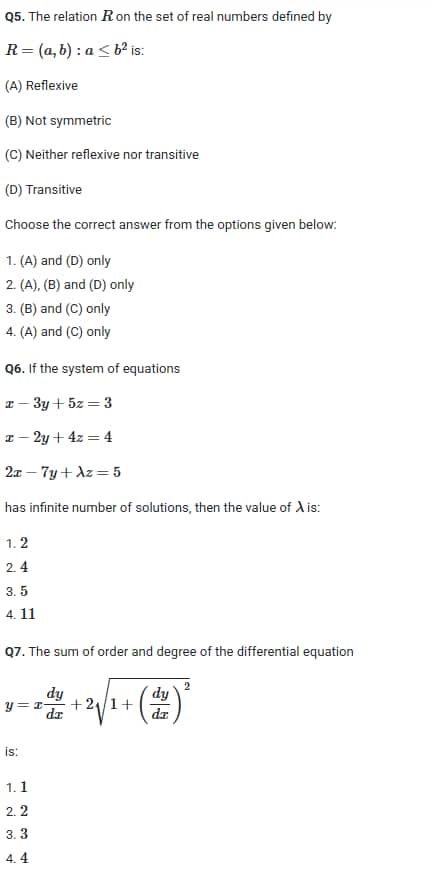
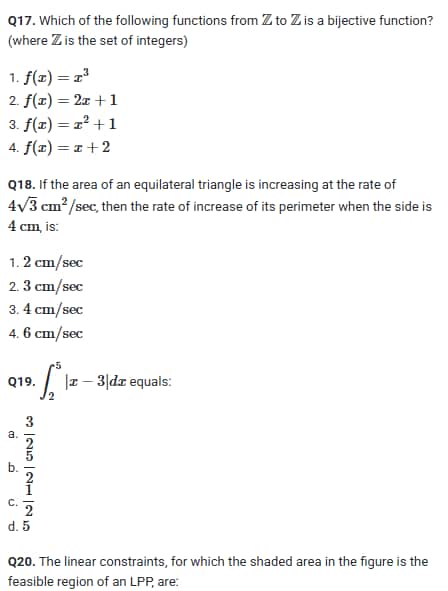
Question on number of Symmetric Relations from Relations and Functions was asked
Questions from Inverse Trigonometric Functions (ITF) were asked
Questions from Matrices were asked
Questions from the Determinants chapter were asked
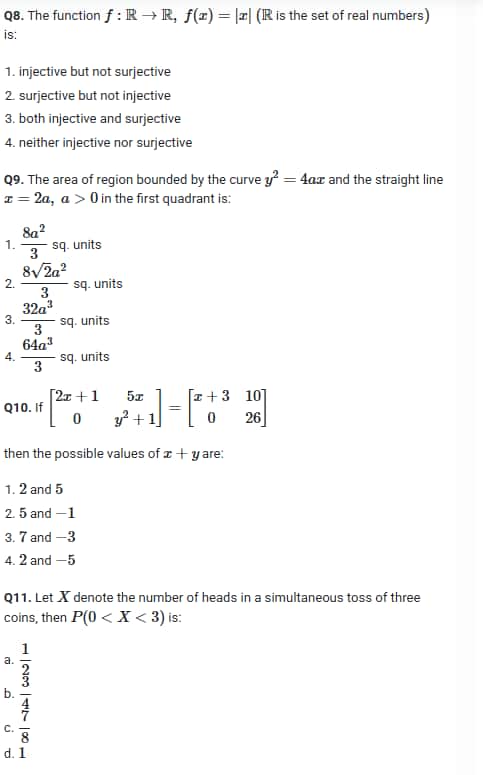
Question from Continuity and Differentiability was asked
Questions from Integrals were asked
Question from Application of Integrals (AOI) was asked
Questions from Vector and 3D Geometry were asked
Around 3-4 questions were asked from Relations and Functions
Around 10-12 questions were asked from Matrices and Determinants
Questions were direct but involved calculations, and some were tricky
Lengthy questions from Differentiation were asked
Questions on Increasing and Decreasing Functions were asked
Around 5-6 questions from Integration were asked
Questions from Application of Integrals were tough
Around 3 questions from Probability were asked
Around 1-2 questions from Vector and 3D Geometry were asked
Overall paper level was moderate to difficult.
Paper had a mix of easy, conceptual, and lengthy questions.
Matching-type questions were asked from multiple chapters.
Calculus and probability had higher weightage.
Chapter-wise Analysis
Relations & Functions
Questions on one-one and onto functions
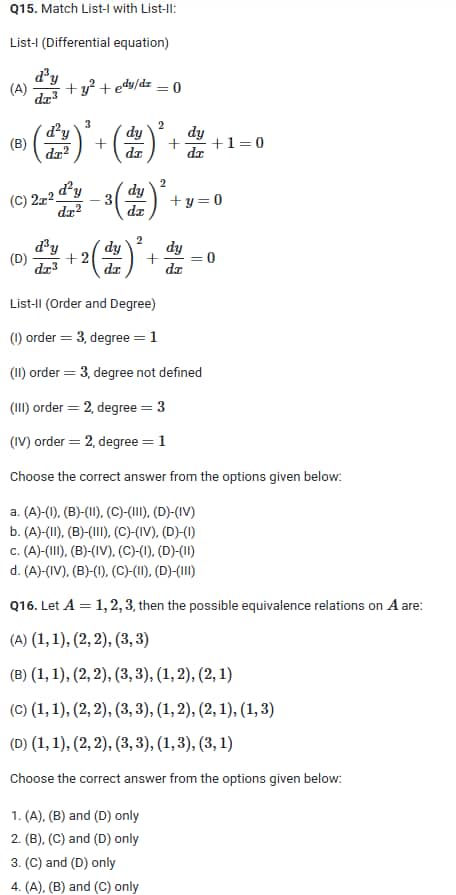
Matching-type question on equivalence relation
One solve-based question from Chapter 2
Matrices
Matching question on:
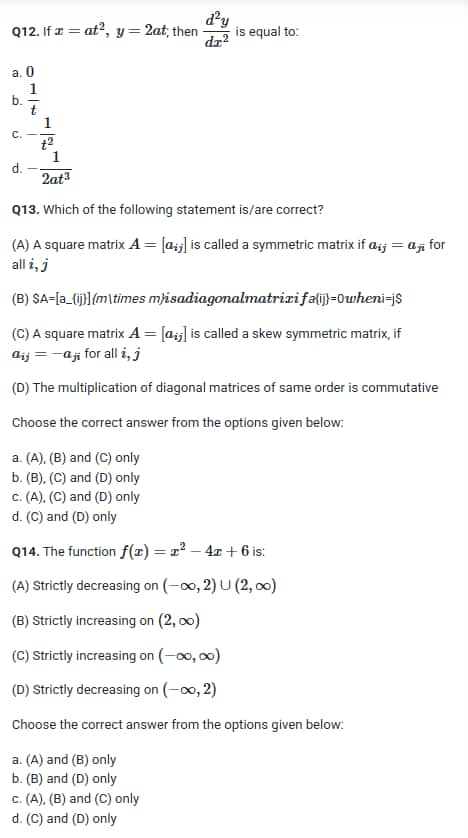
Diagonal Matrix
Scalar Matrix
Unit Matrix
Symmetric Matrix
Determinants
2 matching questions based on |Adj A| concept
Continuity & Differentiability
Question on second-order derivative in parametric form
Application of Derivatives
3-4 questions from increasing/decreasing functions
2 were easy, 2 were comparatively difficult
Integrals
Around 4-5 questions
One standard question based on:
Interval −π to π
Odd function gives 0
Some questions were tough and lengthy
Coordinate Geometry
3 questions:
Parabola equation
Straight line
Combined parabola and line concept
Differential Equations
Questions on:
Order and Degree
Integrating Factor
Normal form
Vectors
Around 3 questions based on unit vector concepts
3D Geometry
1 MCQ-based conceptual question
Linear Programming
Question on identifying the bounded region
Probability
Around 4 questions
Matching question on conditional probability formula
Question based on independent events
NCERT concepts were important throughout the paper.
Students found probability and calculus relatively more important sections.
Some questions were directly formula-based, while others required deeper conceptual understanding.
Paper was lengthy
Questions were more concept-based than direct formula-based
Some questions were calculation-heavy
Matching-type and statement-based questions were asked in multiple chapters
Students who practiced PYQs had an advantage
Major chapters covered:
Relations & Functions
ITF
Continuity & Differentiability
Application of Derivatives
Integrals
Area of Integration
Differential Equations
Vector Algebra
LPP
Probability
Increasing and Decreasing Function questions were asked more
Around 1-2 easy questions from Relations and Functions
Statement-based questions on:
Reflexive
Symmetric
Transitive relations
Questions from ITF were less
ITF questions were mostly direct and PYQ-based
Around 4 questions each from Matrices and Determinants
Matrix questions were tricky
Questions included:
Adjoint of Matrix
Determinants
Inverse Matrix
Differentiation and Integration had high weightage
Around 5 questions from Integration
Logarithmic integral questions were asked
Questions from Vector and 3D Geometry were asked
Vector Algebra section was comparatively easy
Differential Equations had the highest weightage
Around 4-5 questions from Differential Equations
Questions included:
Variable separable method
Integrating Factor method
Order and Degree matching
Only around 3 questions from Probability
Conditional probability questions were asked
LPP questions were easy and direct
Continuity graph-based conceptual question was asked
Overall difficulty:
Calculus → Moderate
Matrices & Determinants → Moderate to Tricky
Differential Equations → Moderate
Vector & LPP → Easy
Probability → Moderate
Overall Paper → Moderate
Key observations:
Differential Equations had the highest weightage
PYQ practice was extremely useful
Matching and statement-based questions increased
Integration and Matrices were important
Time management was crucial because the paper was lengthy
The paper was easy to moderate
The paper was lengthy
Increasing and Decreasing Function questions were asked more
Around 1-2 easy questions from Relations and Functions were asked
Questions from Inverse Trigonometric Functions (ITF) were less
Around 4 questions each from Matrices and Determinants were asked
Matrices questions were tricky
Differentiation and Integration had significant weightage in the paper
Around 5 questions from Integration were asked
Questions from Vector and 3D Geometry were asked
Only around 3 questions from Probability were asked
Overall paper level: Easy to Moderate
Paper was lengthy
Around 35 questions considered a good attempt
2 questions from Relations and Functions (R&F)
Straightforward questions from Inverse Trigonometric Functions (ITF)
Questions from Matrices and Determinants
Formula-based questions from Matrices
Questions on Symmetric Matrices
Equality of Matrices question asked
Questions from Continuity and Derivatives
Questions from Integration
Questions from Application of Integrals
Fewer questions from Vectors and 3D Geometry
Question on Direction Ratio asked
Questions from Linear Programming Problem (LPP)
Questions from Probability
Bayes Theorem question asked
CUET Maths Analysis 15 May (Shift 1)
Overall difficulty level of the paper was moderate
The paper was lengthy, making time management very important
Most questions were based on:
Multiple statements
Match the Following pattern
Students who had good speed and formula revision found the paper manageable
Questions asked and major topics:
Calculus:
Integration had around 5-6 questions
Most were formula-based Match the Following questions
Differential Equations:
Around 5-6 questions
Mostly formula-based and direct concept application
Probability:
Questions from:
Total Probability
Conditional Probability
Matrices and Determinants:
Around 4-5 questions
Included conceptual and calculation-based problems
Continuity and Differentiability:
Around 2-3 questions
Applications of Integration:
Around 2-3 questions
Other topics included:
LPP (Linear Programming Problems)
ITF (Inverse Trigonometric Functions)
Relations and Functions
Around 1-2 questions from each
Calculus had the highest weightage in this shift
Formula memorisation and practice of Match the Following questions were very important
Students were generally able to comfortably attempt around 38-40 questions
Overall, the paper was balanced but lengthy, favouring students with strong calculation speed and regular practice
The overall difficulty level of the Mathematics paper was moderate.
Calculus had comparatively tougher questions than previous year papers (PYQs).
Questions from Application of Derivatives (AOD) included increasing-decreasing functions and local maxima concepts.
Area of Integration (AOI) based questions were asked.
Matching-type questions were asked from Integration formulas and Differential Equations.
Probability had around 4-5 direct conceptual and formula-based questions.
Linear Programming Problems (LPP) included figure-based feasible region and statement-oriented questions.
Vector Algebra and Three-Dimensional Geometry questions were mostly direct and similar to PYQ patterns.
Statement-based and match-the-following questions were seen in Vectors and 3D Geometry.
Questions on Degree and Order of Differential Equations were asked.
Matrices section was comparatively easy and formula based.
Determinants had around 2-3 questions including Adjoint of Matrix, determinant properties like (|A|), (|4A|), and order of matrix-based concepts.
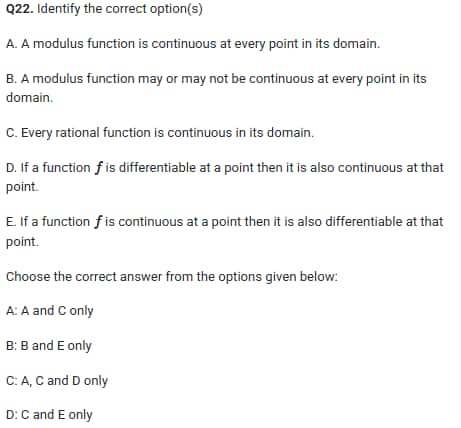
Continuity and Differentiability included statement-based conceptual questions.
Inverse Trigonometric Functions (ITF) had one match-the-following question.
Relation and Function section included a question based on the condition (1 + xy < 0).
Most questions were concept-driven with a mix of direct formula application and statement analysis.
Students who practised NCERT examples along with PYQs found many sections manageable.
Time management was important because matching and statement-based questions
Overall paper difficulty level was moderate but lengthy
Time management was important for attempting the paper efficiently
A few matching-type questions were included
Calculus questions were comparatively difficult
Questions from Application of Derivatives were asked
One question was based on increasing and decreasing functions
One question was asked from local maxima
Application of Derivatives questions were tougher compared to previous year papers
One matching question was based on basic integration formulas
Questions from Vector 3D and 3D Geometry were moderate in difficulty
Vector and 3D Geometry questions were similar to previous year patterns
Questions from Matrices and Determinants were mostly easy
One question from the Adjoint of Matrix was asked
A statement-based question from Continuity and Differentiability was included
Students had to identify true and false statements in one question
Around 4-5 direct questions were asked about Probability
Linear Programming questions were figure-based
One question about the feasibility in Linear Programming was asked
A matching question based on order and degree of differential equations appeared
One question from Inverse Trigonometric Functions (ITF) based on domain and range was asked
Questions from Relations and Functions were included
NCERT and previous year question practice proved useful for the paper
Get expert advice on college selection, admission chances, and career path in a personalized counselling session.
The CUET Mathematics Question Paper 2026 with Solutions PDF will be available after the completion of the CUET Exam. Students will be able to download the question paper along with detailed solutions prepared by Careers360 subject experts.
| Subject | Download Link |
|---|---|
CUET Mathematics Question Paper with Solutions 2026 | To be updated soon |
Students can check and download the CUET UG 2026 Exam Analysis PDFs for different subjects from the table below. These PDFs and e-books are prepared only for exam analysis purposes using memory-based questions, student reactions, and expert analysis.
| CUET UG Subjects | Exam Analysis and Memory-Based Questions PDF |
|---|---|
CUET 2026 English Memory-Based Questions and Analysis | |
CUET UG 2026 Science Memory-Based Questions and Analysis (Physics, Chemistry & Biology) | |
CUET UG 2026 Commerce Memory-Based Questions and Analysis (Economics, Business Studies, Accountancy) | |
CUET UG 2026 Social Studies Memory-Based Questions, Analysis (Pol Science, History, Geography) | |
CUET UG 2026 General Aptitude Test (GAT) Memory-Based Questions and Analysis |

On Question asked by student community
Hi!
Given below is the link to access the CUET 2027 English Vocabulary:
https://university.careers360.com/articles/cuet-2027-english-vocabulary-words
You may also find these helpful:
https://university.careers360.com/articles/50-most-important-phrasal-verbs-for-cuet-ug-2027
https://university.careers360.com/articles/idioms-and-phrases-for-cuet-2027-english-preparation
Hope that helps!
Hi student!
Given below are the links to access the CUET UG Previous Year Question Papers.
Also check:
https://university.careers360.com/articles/cuet-previous-year-question-papers
https://university.careers360.com/articles/cuet-ug-pyq
https://university.careers360.com/articles/cuet-question-papers
Hope it helps!
Hello Divyam,
Download CUET UG PCM memory-based papers from the link below and apply filters to access Physics, Chemistry, and Math resources.
https://www.careers360.com/download/cuet-ebooks-and-sample-papers
Hi,
You can check the CUET Tamil previous year question paper with answer key by clicking on the link below.
Hi,
The total marks of CUET UG for each subject is 250 marks. You can check the CUET OBC cut off marks of previous year by clicking on the link below.

Ranked #45 Among Universities in India by NIRF | Get Upto 100% Scholarships
Application form FREE of Cost for a Limited Period of Time | #11 by NIRF | NAAC A++ Accredited Institution | 1100+ Recruiters
Scholars’ Round Deadline: 14th Nov’26 | Earn upto 50% merit Scholarship + 10% for top performers | EFMD Accredited | AACSB (USA) & AMDISA Member | Highest CTC 28 LPA
Highest CTC 30 LPA | #9 in Management Category by Times B-School | Merit-Based Scholarship Upto - 50 Crores
Admissions open for 4 year full time B.A/B.Sc Liberal Arts & B.A/B.Sc (Liberal Arts) Honours with Research
BA, BA (H), 9 Specializations, B.PES | MA, MA (H), 11 Specializations, M.PES | 12 LPA Highest CTC | 5-6 LPA Average CTC