Amity University, Noida
India’s only private university to be ranked for Graduate Employability | 6000+ Placements | 800+ Recruiters | 75 LPA-Highest Salary


It’s seven in the evening, and a master’s student is still in the lab. The reaction was supposed to give a yield of around 80 %. It gave 12. Most people would pack up. This student stays, rewrites the procedure, changes one variable at a time and finally finds the culprit: a trace of moisture in the solvent.
This Story also Contains
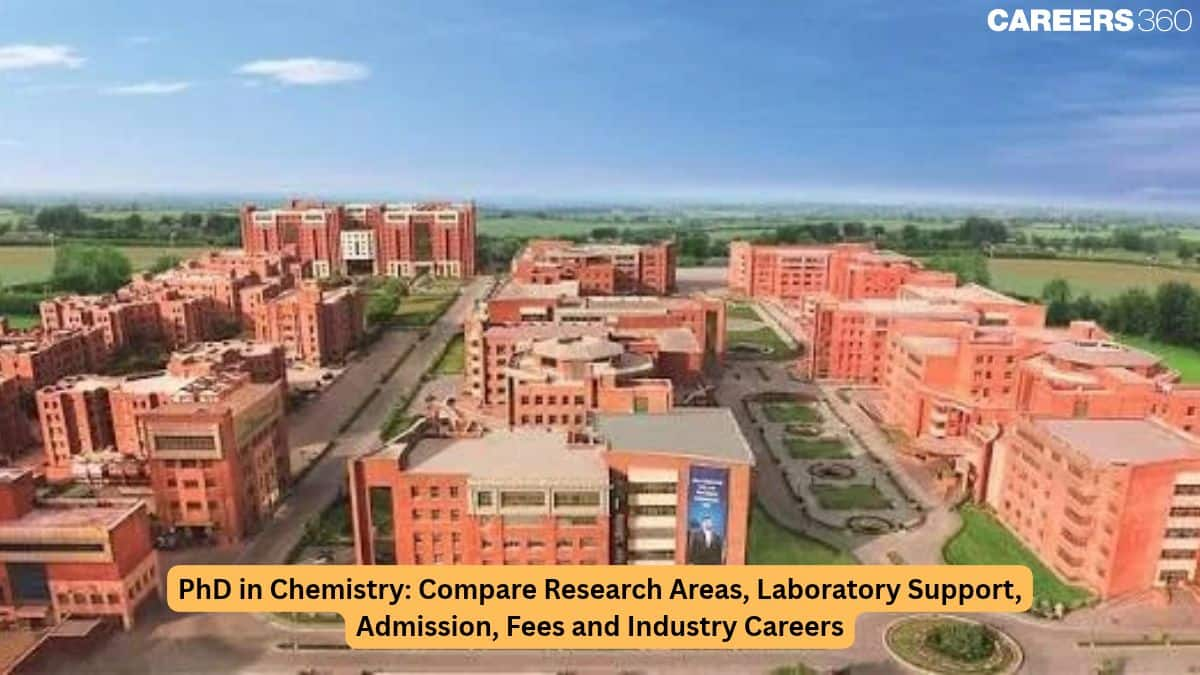
That itch to find out why is what doctoral research in chemistry runs on. But enthusiasm needs the right setting. A PhD in Chemistry feeds into drug discovery, advanced materials, clean energy, environmental testing and academic research, and the options inside it differ hugely. Before applying, it pays to compare research areas, laboratory support, admission rules, costs and career routes side by side. This guide does exactly that.
Also Read: Amity University Noida Admissions
A postgraduate course in chemistry teaches established knowledge and standard techniques. A doctorate asks for something nobody has produced yet: a new compound, a better method, a clearer mechanism, a sharper analysis. That’s the dividing line.
The daily rhythm is experimental. Scholars design experiments, run them, fail often, adjust and repeat. Data analysis follows, using spectroscopy, chromatography, microscopy or computational tools, depending on the field. The thesis then pulls years of results into one argument and has to survive examiners who know the subject deeply.
Real talk: patience is a bigger predictor of success than brilliance. Reactions fail for dull reasons. Instruments book out weeks in advance. A sample goes missing. Applicants who find that process interesting, and not merely tolerable, usually do well. Those who want quick results often struggle in the second year.
Chemistry is broad, and the area chosen shapes the whole experience. The table below sets out common specialisations, what they focus on and where the work tends to be applied.
| Research area | Main Focus | Where it's applied |
|---|---|---|
Organic Chemistry | Synthesising and understanding carbon-based compounds | Pharmaceuticals, agrochemicals, fine chemicals |
Inorganic Chemistry | Metals, coordination compounds, catalysts | Catalysis, energy materials |
Physical Chemistry | Reaction rates, thermodynamics, spectroscopy, computation | Energy, instrumentation, modelling |
Analytical Chemistry | Detecting and measuring substances accurately | Quality control, environmental testing, forensics |
Material Science | Designing materials with specific properties | Electronics, batteries, coatings |
Nanotechnology | Behaviour and use of nanoscale structures | Medicine, sensors, water treatment |
Medical Chemistry | Designing and improving drug molecules | Drug discovery, biotechnology |
Interest alone shouldn’t decide the choice. Three checks help. Does a faculty member already work in that area, so guidance is real? Are the needed instruments available, because a synthesis project without the right analytical equipment stalls quickly? And does the work lead somewhere, whether publications, patents or industry relevance? A topic that satisfies all three is much safer than one that merely sounds exciting.
Also see: Amity University Noida Courses
Most universities offering a PhD in Chemistry India wide follow a similar baseline: a master’s degree in chemistry or an allied subject with at least 55 % marks. Candidates from reserved categories usually receive a 5 % relaxation. Beyond that, each university adds its own filters, such as an entrance test, a research proposal or an interview. Some also accept scores from national-level eligibility tests in place of their own paper. Reading the admission notice line by line avoids avoidable rejections.
The PhD in Chemistry duration is generally a minimum of three years, including coursework, and a maximum of six. The journey moves through coursework, literature review, proposal approval, experimental work, data analysis, thesis writing, evaluation and a viva. Experimental work usually takes the biggest share of the calendar.
What stretches the timeline? A synthesis route that needs repeated optimisation, shared instruments with long queues, delayed results from outside testing, and revision cycles on the thesis all add months. Part-time scholars generally need longer than full-time ones. The commitment also touches life outside the lab, since long experimental days leave limited room for other work.
Chemistry research depends on equipment, so the lab deserves close attention. When comparing programmes, applicants can check the following:
Instruments: access to spectrometers, chromatography systems, microscopy and other tools relevant to the chosen area
Supervision: how many scholars each guide handles and how often progress is reviewed
Journal access: subscriptions and databases that cover current chemistry literature
Funding: fellowships, stipends, contingency grants and conference support
Collaboration: links with other departments, research bodies or industry for shared facilities and projects
India’s only private university to be ranked for Graduate Employability | 6000+ Placements | 800+ Recruiters | 75 LPA-Highest Salary
Among top 2% Universities Globally (QS World University Rankings 2027) | Up to 100% scholarships worth 325 Crores
Costs need the same scrutiny. Beyond the programme fee, scholars should ask about charges for coursework, examinations, thesis submission and instrument usage. Consumables, chemicals and travel for conferences can add up too. Some institutions provide funding for these, while others expect scholars to manage them. Applicants should also look into available fellowships, since a funded place changes the financial picture completely. The sensible question isn’t “what does it cost?” but “what will it cost me, in total, and what support exists?”
Doctoral chemists work in more places than most people expect. PhD in Chemistry jobs span academic institutions, pharmaceutical companies, chemical manufacturing, materials research, biotechnology, quality control and research and development. The table below shows how these routes differ.
| Sector | Typical Work | What shapes the Pay |
|---|---|---|
Academic Institutes | Teaching, supervising, publishing research | Institute type, rank, publication record |
Pharmaceutical companies | Drug discovery, process development, analysis | Role level, specialisation, company scale |
Chemical manufacturing | Process improvement, product development | Plant scale, technical responsibility |
Materials and nanotechnology | Developing new materials and applications | Research output, sector demand |
Biotechnology | Applied research, analytical and formulation work | Employer type, experience |
Quality control and R&D | Testing standards, method development | Industry regulation, seniority |
Money is where honest answers matter. PhD in Chemistry salary has no single figure. It varies with specialisation, employer, experience, job responsibilities and research expertise. Industry roles often pay more than academic ones at the start, though academic posts bring stability and intellectual freedom. Specialisations tied to pharmaceuticals, materials and analytical methods tend to be in demand. Anyone quoting one average salary for the whole field is simplifying a very uneven picture.
Also see: Amity University Noida Facilities
Comparing the top universities for PhD in Chemistry in India starts with a mindset shift: research fit matters more than rankings. A well-known department with no one working in the chosen area is a poor choice. A smaller one with the right supervisor and instruments can be far better.
Faculty research interests come first. Applicants should read recent publications and check whether the work lines up with their proposed direction. Next comes laboratory infrastructure, since a project is only as good as the equipment behind it. Publication records show whether the department produces steady, credible research. Funding opportunities reveal how seriously scholars are supported. Industry collaborations can open doors to applied projects and later employment. And doctoral support, from seminars to writing help, affects how smoothly the years pass.
A simple test works well. Ask to speak with current scholars and request a list of recently completed theses. How long did they take? Where did those scholars go next? The answers say more than any brochure.
Applicants who’ve run their options through these criteria can check any shortlisted programme the same way. PhD in Chemistry at Amity University Noida is worth including.
The programme is listed with a full-time route of three years, and a part-time route is also listed. Eligibility is listed as a master’s degree in chemistry or an allied discipline from an accredited Indian or foreign university, with a minimum of 55 % marks or an equivalent grade. Selection is listed as a subject-based written test followed by a personal interview. Because chemistry research depends on instruments and supervision, applicants should ask about the specific laboratories and faculty linked to their area of interest. Fee details are published by the university and are best confirmed directly.
Interested applicants can visit the official PhD Chemistry programme page for current admission dates, requirements and fee information.
Disclaimer: This article has been published as a part of a marketing collaboration between Careers360 and Amity University.
Frequently Asked Questions (FAQs)
A master’s degree in chemistry or an allied subject with at least 55 % marks is the usual requirement, with a 5 % relaxation for reserved categories. Entrance tests, proposals and interviews depend on the university.
The usual minimum is three years including coursework, with a maximum of six. Experimental complexity, instrument access, publication requirements and thesis revisions affect completion time, and part-time scholars generally need longer than full-time ones.
Common areas include organic, inorganic, physical and analytical chemistry, materials science, nanotechnology and medicinal chemistry. The best choice matches personal interest with faculty expertise, available instruments, funding and realistic applications.
Graduates work in academia, pharmaceutical firms, chemical manufacturing, materials research, biotechnology, quality control and research and development. Salary varies with specialisation, employer, experience and responsibilities, so no single figure applies.
Compare faculty research interests, laboratory infrastructure, instrument access, publication records, funding options, industry links and doctoral support. Research fit with a supervisor matters more than rankings, so speaking to current scholars helps.

On Question asked by student community
Hello Student,
For Amity Institute of Biotechnology, Noida, PCB students can be eligible for BTech programmes with the specified eligibility. Careers360 lists 60% aggregate in Class 12 with PCB/PCM for non-sponsored candidates and 55% for sponsored candidates. However, eligibility can differ for BTech CSE at different Amity campuses. Therefore, check
Hello Student, both Amity Noida and Amity Gurugram can be considered for MCA, but the better choice for you depends on factors such as fees, placements, campus environment, location, curriculum, internships and your career goals. If your priority is a larger campus and broader exposure, Noida may be worth considering.
Hello,
Sorry, we are currently not covering Amity University Lucknow
BDes
sample questions/papers. You can check the official Amity website for sample paper questions.
Agar aap UP Board se Class 12 PCB kar rahe ho aur B. Tech CSE karna chahte ho, to Mathematics ki eligibility requirement complete karna important hai. NIOS se additional Mathematics lene ka option useful ho sakta hai, lekin admission se pehle apne UP Board + NIOS subject combination ki
Minor mismatches in your Aadhaar card and Class 10 marksheet don't automatically make you ineligible for admission. Universities usually consider your academic documents, but you'll likely be asked to provide supporting documents or get the discrepancy corrected. It's best to contact the admissions office and explain the situation before completing

India’s only private university to be ranked for Graduate Employability | 6000+ Placements | 800+ Recruiters | 75 LPA-Highest Salary
Among top 2% Universities Globally (QS World University Rankings 2027) | Up to 100% scholarships worth 325 Crores
NAAC A-Grade | UGC Autonomous
Highest CTC 20.56 LPA | Average CTC 11.4 LPA | 250+ Recruiters | 2nd Position in Pune.
Grade 'A+' accredited by NAAC
Top B School in South | Pre-Placement Offers | Higher Stipends