
Search Colleges, Exams, Schools & more


Login
Is a PhD in Economics Right for You? A Guide for Indian Applicants

A final-year master’s student sits in an economics seminar. A visiting researcher is presenting a paper on rural credit, and one thought keeps nagging: I’d rather be the one asking these questions. Elsewhere, a policy analyst keeps hitting the same wall. The reports need answers that the available data can’t give. A third candidate wants a lectureship and knows the doctorate is the entry ticket.
This Story also Contains
- Understanding What a PhD in Economics Really Demands
- PhD in Economics Eligibility and Admission Rules to Check Before Applying
- Finding the Right PhD in Economics Topics and Research Areas
- Planning for PhD in Economics Duration and the Years Ahead
- Weighing Career Options and PhD in Economics Salary in India
- Choosing the Best University for PhD in Economics Research
- Exploring the PhD in Economics at Amity University Noida
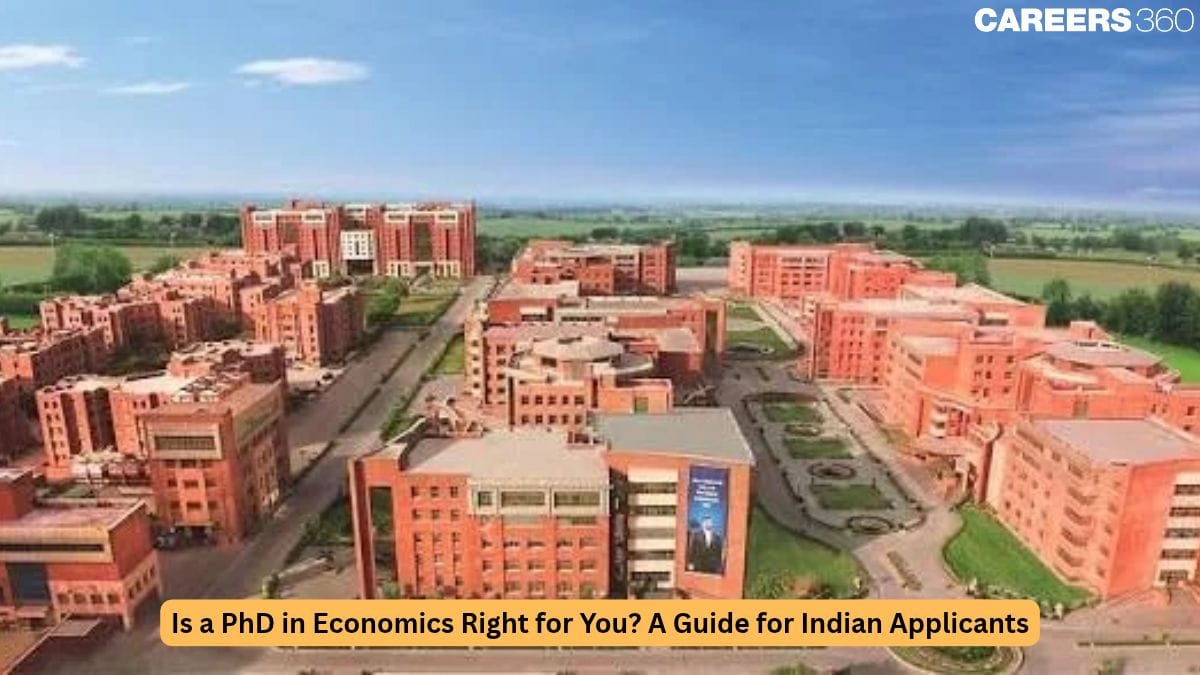
Three different routes, one shared decision. A PhD in Economics isn’t a master's degree. It means years of self-directed thinking, rejected drafts and a thesis that has to add something new. So before any form is filled in, a few honest questions need answers.
Does the work excite or merely impress?
Do the eligibility rules fit?
Does the supervision on offer match the research interest?
What follows takes each one in turn, from the daily reality to the pay.
Also Read: Amity University Noida Admissions
Understanding What a PhD in Economics Really Demands
A postgraduate programme teaches existing theory and tools. A doctorate asks for a contribution. That’s the core difference. Scholars usually spend the first stretch on coursework in advanced micro, macro and econometrics. Then comes the part that defines the degree: an original research question, tested with data and defended before examiners.
Independence is what surprises most people. Nobody hands over a timetable. Supervisors guide, but the scholar drives. Weeks can vanish into a model that won’t converge or a dataset full of gaps. Real talk: motivation matters more than marks here.
Three traits tend to separate those who finish from those who drift. Comfort with quantitative methods. Patience with slow progress. A question that still feels interesting in year three. Without the last one, the first two rarely hold up.
PhD in Economics Eligibility and Admission Rules to Check Before Applying
Most universities offering a PhD in Economics in India follow a common baseline: a master’s degree in economics or an allied subject with at least 55 per cent marks, or an equivalent grade. Candidates from reserved categories and those with disabilities usually receive a 5 per cent relaxation. Some routes also accept a four-year bachelor’s degree with a research component and a strong score, though this varies by institution.
Marks alone don’t settle it. PhD in Economics eligibility at each university adds its own layer: an entrance test, a research proposal, an interview, or some mix of the three. A few universities accept national-level eligibility test scores instead of their own paper. Others insist on their own. Applicants should read each admission notice line by line, because one missed document or deadline can cost a full cycle.
One practical point. A proposal, even a rough one, shows the panel how the applicant thinks. Two focused pages on a real question beat ten pages of general enthusiasm.
Finding the Right PhD in Economics Topics and Research Areas
Choosing a research area is the most personal decision in the process. It’s also the most consequential. Common PhD in Economics topics include:
Development economics: poverty, rural livelihoods, microfinance and welfare schemes
Public finance: taxation, subsidies, fiscal federalism and state budgets
Monetary policy and banking: inflation, interest rate transmission and financial stability
International trade: export competitiveness, trade agreements and global value chains
Labour economics: employment patterns, wages, informal work and skills
Behavioural economics: where real decision-making departs from textbook models
Environmental economics: carbon pricing, resource use and climate-linked costs
A topic isn’t picked off a list, though. Three checks help. Will it hold interest for years? Is the data actually available? A brilliant question with no data is a dead end. And does a faculty member already work nearby, so the guidance is real rather than nominal?
Relevance counts too. Questions tied to live policy debates, such as the energy transition or digital payments, tend to draw more readers and, often, more funding interest.
Also see: Amity University Noida Courses
Planning for PhD in Economics Duration and the Years Ahead
Regulations generally set the PhD in Economics duration at a minimum of three years, including coursework, and a maximum of six. Extensions may be allowed in specific cases. Many full-time scholars finish in the four-to-five-year band, and part-time scholars usually take longer.
What moves the clock? Research design decides a lot. A study built on public datasets moves faster than one that needs field surveys. Coursework has to be cleared first. Data cleaning eats months nobody planned for. Then come thesis writing, supervisor feedback, revisions, a pre-submission seminar and the final viva.
Applicants also need to think about life outside the degree. Several years of focused research means delayed earnings for some, or a tricky balance with a job for others. That’s a trade-off worth naming early, not discovering in year two.
Weighing Career Options and PhD in Economics Salary in India
Doctoral training opens doors that a master’s often doesn’t. Academia is the obvious one. But research institutes, policy bodies, consulting firms, banks and financial institutions, and development organisations also hire doctorates for work that needs original analysis.
Money is where honest answers matter. PhD in Economics salary in India has no single figure. It shifts with the role, the employer, years of experience, specialisation and the strength of the research record. A university post follows a defined pay structure. A consultancy or financial institution may pay more for in-demand quantitative skills. A research organisation may pay less but offer more intellectual freedom. Anyone quoting one neat average is simplifying.
| Career path | Typical Work | What shapes the pay |
|---|---|---|
Academia | Teaching, supervising, publishing | Institution type, rank, publication record |
Economic research | Studies, forecasting, reports | Employer, funding, seniority |
Public policy | Advising, evaluating schemes | Government or non-government, level of role |
Consulting | Client analysis, modelling | Firm, domain expertise, seniority |
Financial institutions | Risk, macro analysis, strategy | Role, quantitative depth, experience |
Specialisation matters as well. Econometrics and data-heavy fields tend to be in demand across private employers, while theory-led work often points toward academia.
Choosing the Best University for PhD in Economics Research
The best university for PhD in Economics isn’t whichever name ranks highest. It’s the one that fits the research interest. Faculty comes first. Applicants should read the recent publications of possible supervisors. If nobody’s work lines up with the proposed topic, supervision will stay thin, however famous the campus.
Next, look at how supervision actually works. How many scholars does each guide handle? How often is progress reviewed? Is there a research advisory committee? Then check resources: library and journal access, statistical software, data repositories and regular seminar series. Interdisciplinary openings matter too, since modern economics borrows heavily from data science, law, environmental science and public policy.
Finally, programme requirements deserve a hard look. Coursework load, publication norms, full-time or part-time mode and submission timelines all affect the experience. And one shortcut is underrated: ask current scholars what supervision feels like week to week. Brochures never say that.
Also see: Amity University Noida Facilities
Exploring the PhD in Economics at Amity University Noida
Applicants who’ve worked through the criteria above can measure any shortlisted programme against them. PhD in Economics at Amity University Noida deserves a place on that shortlist.
The programme is listed as a part-time doctoral route, with a duration of about three and a half years. Eligibility is listed as a master’s degree in economics from a recognised Indian or foreign university, with a minimum of 55 per cent marks or an equivalent grade. Selection is listed as a subject-based written test followed by a personal interview. Scholars work on a research area chosen with faculty guidance, so the topic-and-supervisor match discussed earlier applies directly. The programme also sits within a multidisciplinary university, which can help scholars whose questions cross subject lines.
Applicants who want current admission details, dates and requirements can visit the official PhD Economics programme page before making a decision.
Disclaimer: This article has been published as a part of a marketing collaboration between Careers360 and Amity University.
Frequently Asked Questions (FAQs)
Q: What are the eligibility requirements for a PhD in Economics in India?
A:
Most universities ask for a master’s degree in economics or an allied subject with at least 55 per cent marks, with a 5 per cent relaxation for reserved categories. Many also require an entrance test, proposal and interview.
Q: What topics can I research during a PhD in Economics?
A:
Popular areas include development economics, public finance, monetary policy, international trade, labour economics, behavioural economics and environmental economics. The best choice combines genuine interest, available data and a supervisor already working in that area.
Q: How long does it take to complete a PhD in Economics?
A:
The usual minimum is three years including coursework, and the maximum is six. Many full-time scholars take four to five years, while part-time candidates often take longer depending on research design, data collection and thesis revisions.
Q: What is the salary after a PhD in Economics in India?
A:
No single figure applies. Pay depends on the role, employer, experience, specialisation and research record. University posts follow set pay structures, while consulting and financial roles may pay more for strong quantitative and data skills.
Q: How should I choose a university for a PhD in Economics?
A:
Start with faculty research interests, then check supervision structure, library and data access, programme requirements and interdisciplinary options. Speaking to current scholars about supervisor availability gives a clearer picture than rankings alone.
Articles
Upcoming University Exams

Certifications By Top Providers
Explore Top Universities Across Globe
List of Related colleges
Questions related to Amity University, Noida
On Question asked by student community
Have a question related to Amity University, Noida ?
Hello Student,
For Amity Institute of Biotechnology, Noida, PCB students can be eligible for BTech programmes with the specified eligibility. Careers360 lists 60% aggregate in Class 12 with PCB/PCM for non-sponsored candidates and 55% for sponsored candidates. However, eligibility can differ for BTech CSE at different Amity campuses. Therefore, check
Hello Student, both Amity Noida and Amity Gurugram can be considered for MCA, but the better choice for you depends on factors such as fees, placements, campus environment, location, curriculum, internships and your career goals. If your priority is a larger campus and broader exposure, Noida may be worth considering.
Hello,
Sorry, we are currently not covering Amity University Lucknow
BDes
sample questions/papers. You can check the official Amity website for sample paper questions.
Agar aap UP Board se Class 12 PCB kar rahe ho aur B. Tech CSE karna chahte ho, to Mathematics ki eligibility requirement complete karna important hai. NIOS se additional Mathematics lene ka option useful ho sakta hai, lekin admission se pehle apne UP Board + NIOS subject combination ki
Minor mismatches in your Aadhaar card and Class 10 marksheet don't automatically make you ineligible for admission. Universities usually consider your academic documents, but you'll likely be asked to provide supporting documents or get the discrepancy corrected. It's best to contact the admissions office and explain the situation before completing

Applications for Admissions are open.
India’s only private university to be ranked for Graduate Employability | 6000+ Placements | 800+ Recruiters | 75 LPA-Highest Salary
Chandigarh University, Chandigarh
ApplyAmong top 2% Universities Globally (QS World University Rankings 2027) | Up to 100% scholarships worth 325 Crores
International Institute of Business Studies, Bangalore
ApplyNAAC A-Grade | UGC Autonomous
International School of Business and Media, Pune
ApplyHighest CTC 20.56 LPA | Average CTC 11.4 LPA | 250+ Recruiters | 2nd Position in Pune.
Nirma University, Ahmedabad
ApplyGrade 'A+' accredited by NAAC
International School of Management Excellence, Bangalore
ApplyTop B School in South | Pre-Placement Offers | Higher Stipends