ICFAI Hyderabad BA Admissions 2026
Merit Scholarships | NAAC A+ Accredited | Top Recruiters: Nvidia, CISCO, Genpact, Amazon & many more


IIMB UG Exam Analysis 2026: The IIMB UG Entrance Exam 2026 is being held by the Indian Institute of Management Bangalore on December 13, 2025 and has now concluded. The IIMB UG exam witnessed a wide participation of aspirants, many of whom are aiming to get admission in IIM Bangalore’s undergraduate programmes. This exam analysis, which has been uploaded on this page, provides an overall overview of how each section played out and what kind of questions showed up in the exam. The goal is to give students a clearer sense of how they performed and what the 2026 cut-offs might look like once IIMB UG 2026 results are released.
This Story also Contains
Aspirants planning to take admission to the undergraduate course must go through the IIMB UG 2026 Exam Pattern. The exam assesses language skills, quantitative ability, and logical reasoning. Being aware of the exam pattern helps the candidates to prepare well.
Aspects | Details |
Conducting Body | IIM Bangalore (IIMB) |
Exam Mode | Online (Computer-Based Test) |
Question Type | Multiple Choice Questions only |
Total Questions | 60 |
Sectional Breakdown | English Comprehension: 15 questions |
Duration | 120 minutes |
Marking Scheme | For each correct answer: +3 |
The overall analysis of the IIMB UG 2026 exam has been provided below to help students prepare for the future.
QA and DI made the paper lengthy and calculative
VA and LR were relatively easy
Due to strong performance in VA and LR, the overall cut-off is expected to be high
Section | Number of Questions | Time Limit | Good Attempt |
Verbal Ability | 15 | 40 mins | 13-15 |
Logical Reasoning | 15 | 40 mins | 13-15 |
Quantitative Ability | 30 | 40 mins | 18-22 |
Total | 60 | 120 mins |
It will be shared soon. Stay tuned!
The memory-based questions of the IIMB UG 2026 exam, along with their solutions, are given below. Students can download it to look through the types of questions asked, revisit their answers, and understand how each problem is solved. Having access to the solved papers is especially useful for anyone planning to retake the exam or for future applicants who want a clear sense of the exam’s difficulty and style. All sections of the paper will be uploaded here. The IIMB UG 2026 question paper PDFs will help students to:
Observe how different question formats are presented.
Recognise common themes and the level of difficulty.
Build confidence for future entrance tests or mock practice.
Title | Download Link |
IIMB UG 2026 Memory-Based Question Paper and Exam Analysis PDF |
To learn more about the IIMB UG 2026 exam's difficulty level, students can go through the section-wise IIMB UG analysis below.
The Quantitative Ability section was more difficult compared to the sample paper. It was highly calculative and time-consuming, which made it challenging for many students.
Questions covered a wide range of topics:
Probability: 2 questions
Matrices: 2 questions
Profit and Loss: Questions asked
Time and Work: Questions asked
Continuity: Questions asked
Trigonometry: Questions asked
Functions: 2 questions
Differentiation: 1 question
Sets: Union and intersection-based questions
Logarithm
Indices
HCF and LCM
Due to heavy calculations, QA took more time. Most students attempted around 19–20 questions in this section.
Topic | Number of Questions |
DI – 2 Sets Pie with Bar Bar | 8 (4) (4) |
Numbers, Factors, Remainders, HCF-LCM | 1–2 |
Arithmetic (%, P&L, SI-CI, Mixtures, Averages, Time and Work) | 6–8 |
Geometry, Trigonometry and Co-ordinate | 3–4 |
Logarithm, Indices and Surds | 2–3 |
Functions and graphs, AP/GP | 5–6 |
Set Theory, Probability and P&C | 2–3 |
Matrices and Determinants | 3 |
Total | 30 Q |
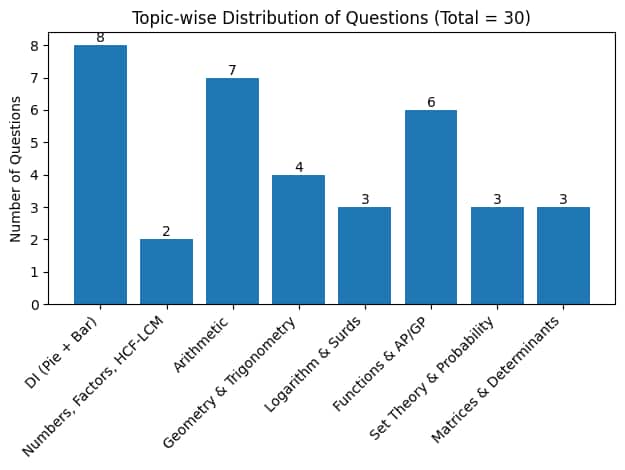
The DI section was very calculative and required careful reading and multiple steps. Although the questions were doable, they were time-consuming, which affected overall attempts.
Many students felt that DI consumed more time than expected. Questions covered were from:
Pie chart: Difficult questions
Bar graph: Easy questions
The LR section was easy to moderate and manageable for most students.
Topics included:
Arrangements
Coding and decoding
Mathematical operations
Data Sufficiency
Direction Sense
Blood Relation
Statement Assumption
Students were comfortable in this section, with most attempting around 20 questions.
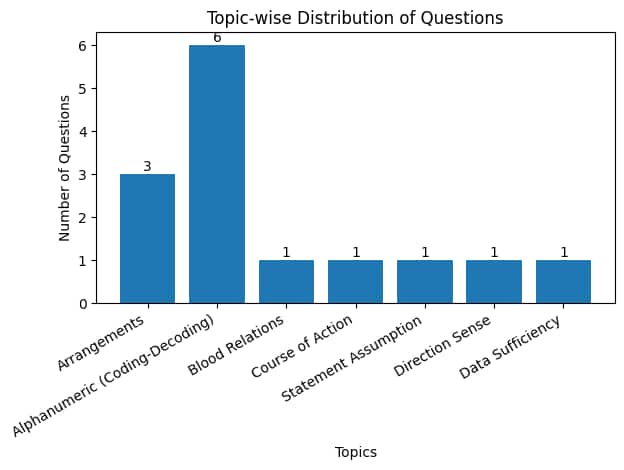
Topic | Number of Questions |
Arrangements | 3 |
Alphanumeric questions (Coding Decoding) | 5–6 |
Blood relations | 1 |
Course of Action | 1 |
Statement Assumption | 1 |
Direction Sense | 1 |
Data Sufficiency | 1 |
Total | 15 Q |
The VA section was easy to moderate and student-friendly. This section helped balance the overall paper.
Questions included:
Reading Comprehension (RC): Easy
Parajumble questions
Adverb-based questions
Idioms and Phrases
Fill in the blanks
Since VA was straightforward, it helped students improve their overall score.
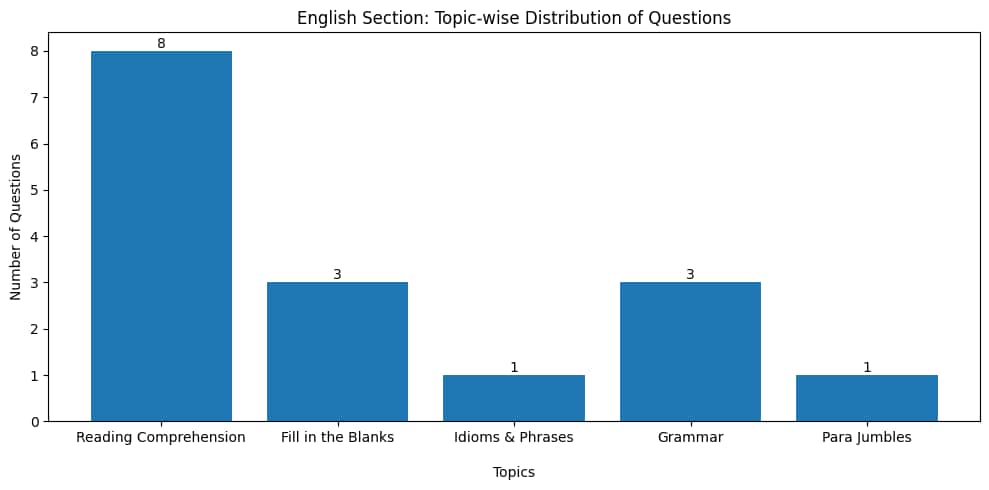
Topic | Number of Questions |
Reading Comprehension | 8 |
Passage 1 – Traditional Medicines | 4 |
Passage 2 – Visual Impairment – Women | 4 |
Fill-in-the-blanks (Close, Preposition) | 2–3 |
Idioms and Phrases | 1 |
Grammar (Adverbs, etc.) | 2–3 |
Para jumbles | 1 |
Total | 15 Q |
Understanding Difficulty Shifts
A close look at the IIMB UG 2026 paper helps students see how the difficulty level changed across sections, making it easier to recognise which areas demanded stronger preparation.
Spotting Common Question Styles
The analysis highlights recurring question types and themes, giving aspirants clearer insight into what the exam tends to emphasise year after year.
Reflecting on Personal Performance
By comparing their attempts with the expected standard of the IIMB UG 2026 paper, students can judge where they performed well and where improvement is needed.
Frequently Asked Questions (FAQs)
Yes, completely. Most students walk out feeling uncertain, especially when the paper has a mix of easy and tricky questions.
It can’t give a guarantee, but it can give you a fair sense of where you stand.
Once you know how you performed, it becomes easier to plan. You’ll know whether to wait confidently for results, prepare for the interview and documents for counselling, or think about improving certain areas if you want another attempt later.
It points out the main question types, important topics, and common areas where students make mistakes. This helps you understand your overall performance.
Begin by noting the difficulty level, checking which sections felt strong or weak, and thinking about how well you managed your time.


NAAC Accredited | #7 by IIRF in Uttar Pradesh | Scholarships Available
Last Date to Apply: 17th August | QS I-Gauge Diamond Rated | NAAC A+ Accredited | 621 Recruitment Partners | INR 40 LPA Highest CTC | 4482 Job offers
B.A. at SCSVMV | Accredited by NAAC 'A' Grade | AICTE Approved | NCTE, NCISM & UGC Approved | 100% Placement Support
Future-Focused Academic Pathways | AI-Era Education for Future Careers
NAAC A++ Accredited | Ranked #12 by NIRF
Education World: Ranked 2nd in Jharkhand by Education World India Private Universities Ranking-2021