Management Development Institute, Gurgaon
Top B-School: Ranked #9 in NIRF Management Rankings 2025.


Parul University has received a grant of Rs 3.065 crore from the Indian Council of Medical Research (ICMR) under its Intermediate Grant scheme for a three-year research project for development of an AI-enabled wearable patch for the early prediction and monitoring of stress and depression. The project aims to combine wearable biosensing with Artificial Intelligence and Machine Learning for non-invasive mental health screening and monitoring.
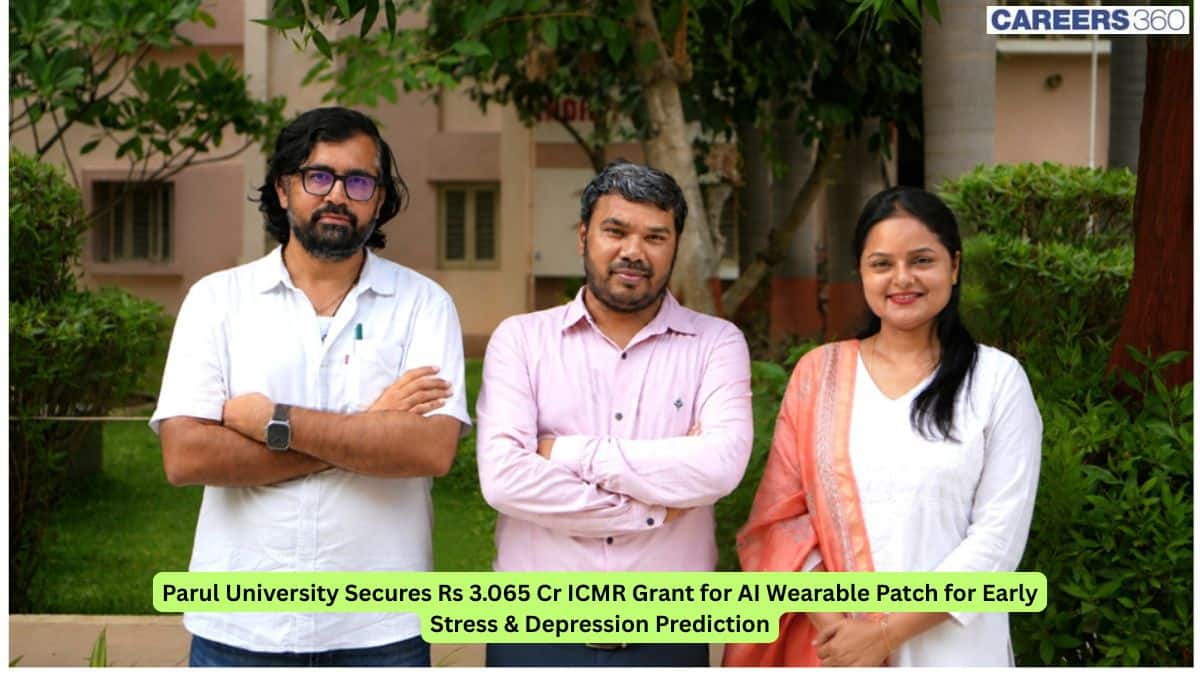
The principal investigator of the research project is Dr. Ramji Gupta with Dr. Nivedita Priya and Dr Anupsinh H. Chhasatia from Parul University as co-principal investigators. The project will involve Dr. Jaspal Singh, Scientist F, Technology Director, C-DAC Mohali as an external collaborator bringing together expertise in engineering, allied health sciences and clinical psychiatry.
Also See: Parul University Vadodara Admissions
The wearable patch will use sweat cortisol and Galvanic Skin Response (GSR) signals, as well as machine learning and artificial intelligence, to analyse physiological changes related to stress and depression. The researchers aim to build a non-invasive wearable system to help with early screening and monitoring of mental health, offering a technology-based response to an increasing and important healthcare requirement.
The project is also expected to enhance the research ecosystem of Parul University in AI, wearable biosensors, physiological signal processing, biomedical technology and digital health. The interdisciplinary nature of this will open up avenues for students and researchers to be involved in advanced research, publications, patents and future technology development through engineering and clinical collaboration.
Talking about the grant, Dr. Ramji Gupta, Principal Investigator, said “This project brings together wearable biosensing and artificial intelligence to enable earlier and more accessible assessment of stress and depression. We hope this work can contribute to developing practical technologies for timely mental health intervention.”
Read More: Parul University Courses
Dr Anupsinh H Chhasatia, Co-Principal Investigator, Parul University, said, “The central objective of this project is to explore how wearable biosensing and Artificial Intelligence can support earlier identification of physiological indicators associated with stress and depression. By integrating sweat cortisol and Galvanic Skin Response signals with AI and Machine Learning, we are working towards a non-invasive technology that can enable continuous monitoring and potentially support more accessible mental-health screening. The ICMR support provides a significant impetus to advancing this interdisciplinary research towards a meaningful healthcare application.”
Dr. Nivedita Priya, Co-Principal Investigator, Parul University, said, “This project brings together engineering, biosensing, physiological signal analysis and healthcare expertise to address an important challenge in mental-health monitoring. Developing a wearable platform that can capture relevant physiological signals and interpret them through intelligent computational models presents an opportunity to make monitoring more personalised and technology-driven. We look forward to advancing this research through a strong interdisciplinary approach and translating the outcomes into a solution with wider societal relevance.”
Read More: Parul University Placements
The three-year initiative underscores Parul University’s focus on interdisciplinary research and indigenous healthcare technology aligned with national priorities like Make in India, Atmanirbhar Bharat and Digital India, while bolstering the university’s contribution to technology-driven healthcare research.
Disclaimer: This article has been distributed by Parul University and has been published as a part of Careers360 marketing initiative.
On Question asked by student community
Hello Dear Student,
For M.Tech in Artificial Intelligence and Data Science at Parul University:
Hostel expenses vary depending on room type and occupancy:
No, the application fee at Parul University is generally non-refundable. While the university may have specific refund policies for other fees, the application fee itself is typically not eligible for a refund unless stated otherwise, according to Parul University's official policy.
Hello,
Parul University in Vadodara offers a well-rounded Arts, Humanities, and Social Sciences program. The university boasts experienced faculty, modern infrastructure, and a diverse curriculum that encourages critical thinking and creativity. Students benefit from various extracurricular activities and strong industry connections. However, it's advisable to check recent student reviews and
Hello Aspirant,
Hope you are doing great. Candidates interested in pursuing a career in visual merchandising can enroll in diploma, degree, post-graduate, or certificate programmes. 10+2 is the minimum requirement for applying to visual merchandising degrees at various institutes/colleges/universities. Candidates should budget between Rs. 4 lakh and Rs. 5 lakh
Hi Aspirant!
Parul University , Gujarat offers a various number of programs in different fields such as Science, medicine , architecture, mathematics, engineering, animation and design, commerce, computer application and IT, Law, management, pharmacy and much more.
The admission to any of these courses is done one the merit basis

Top B-School: Ranked #9 in NIRF Management Rankings 2025.
NAAC A-Grade | UGC Autonomous
Highest CTC- 21 LPA | Average CTC- 10.38 LPA | Scholarships Available
Highest CTC 20.56 LPA | Average CTC 11.4 LPA | 250+ Recruiters | 2nd Position in Pune.
Grade 'A+' accredited by NAAC
Top B School in South | Pre-Placement Offers | Higher Stipends