Management Development Institute, Gurgaon
Top B-School: Ranked #9 in NIRF Management Rankings 2025.


A great deal of modern science and engineering happens at scales the eye cannot perceive. The behaviour of materials, the design of electronic components, the delivery of medicines, and the development of sensors all increasingly depend on understanding and manipulating matter at the micro and nano scale, dimensions measured in millionths and billionths of a metre.
This Story also Contains
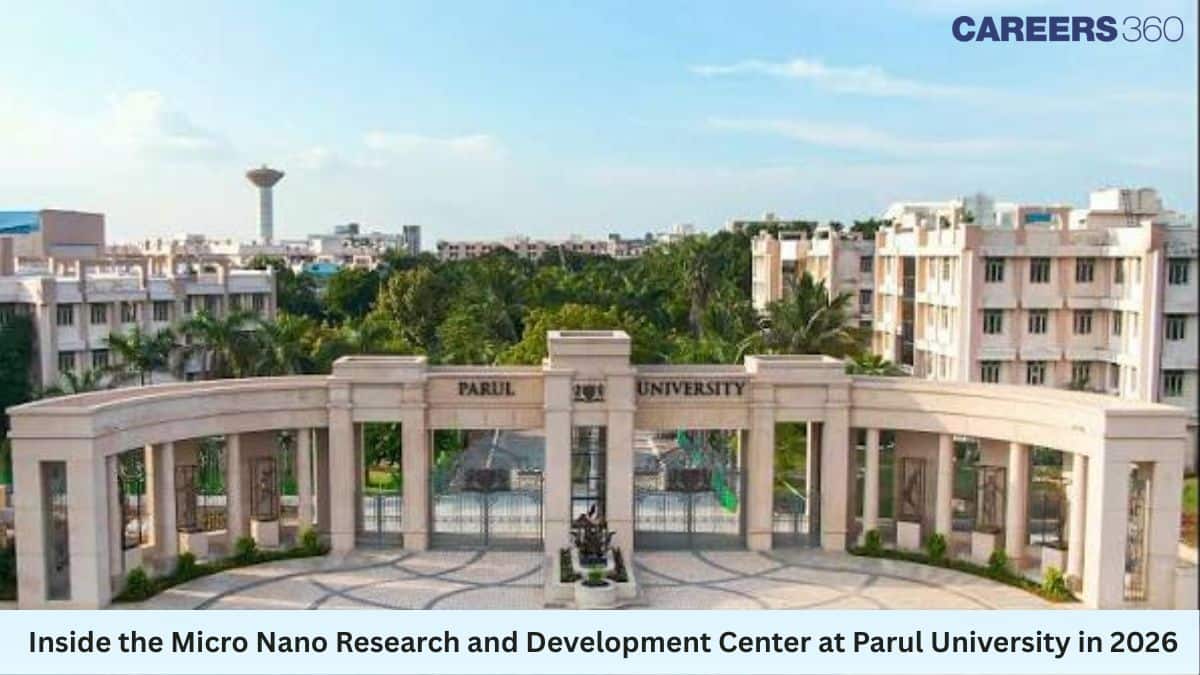
The Micro Nano Research and Development Center at Parul University is a facility dedicated to research at exactly these scales. This guide explains what micro and nano research involves, what the presence of a dedicated and government-approved centre indicates about a university, how such a facility connects to everyday technology, and why it matters to a prospective student even in disciplines that seem distant from it.
Also See: Parul University Admission
The prefixes describe scale. A micrometre is a millionth of a metre, roughly the size of a bacterium. A nanometre is a billionth of a metre, the scale of individual molecules. Research at these dimensions matters because materials behave differently there than they do at everyday sizes.
A material's strength, conductivity, reactivity, and optical properties can change dramatically at the nano scale, which allows scientists to engineer materials with properties that would be impossible to achieve otherwise. This is the foundation of a great deal of contemporary technology, from the processors in electronic devices to advanced drug delivery systems to highly sensitive environmental and medical sensors. Understanding and controlling matter at this scale is, in a real sense, one of the central projects of modern science and engineering.
At the nano scale, a millionth or a billionth of a metre, familiar materials behave in unfamiliar and useful ways.
The Micro Nano Research and Development Center at Parul University is approved by the Industries Commissionerate of Gujarat, a government recognition that situated the facility within the state's industrial and research infrastructure. It is one of six dedicated research centres at the university, alongside a Research and Development Centre recognised by the Department of Scientific and Industrial Research, an AICTE-supported Drone Lab, a state-sponsored Supercomputer Lab, a Centre for Future Skills, and a NABL-accredited Environmental Lab.
Government approval and recognition matter because they are conferred against defined criteria and are externally verifiable. A research centre that carries an external approval has met a standard set by someone other than the university, which distinguishes a genuine research facility from a well-equipped room described as one. For a prospective student, this is the same principle that runs through sound assessment of any institution: a claim confirmed by an outside body is worth more than the same claim made by the institution about itself, and the recognitions attached to these centres can each be checked with the body that granted them.
Also See: Parul University Courses
Micro and nano research is often assumed to concern only physics or materials science. In fact its reach is unusually broad, which is why a dedicated centre benefits students across many disciplines.
Engineering: Electronics, sensors, and advanced materials all draw on micro and nano fabrication and characterisation.
Pharmacy and medicine: Nano-scale drug delivery systems are among the most active areas of pharmaceutical research, connecting directly to work elsewhere in the university.
Environmental science: Nano-materials are used in sensing and in the treatment of pollutants, linking to environmental research.
Applied sciences: The fundamental physics and chemistry of the nano scale underpin research across the sciences.
Top B-School: Ranked #9 in NIRF Management Rankings 2025.
UG & PG Scholars’ Round Deadline: 14th Nov’26 | Earn upto 50% merit Scholarship + 10% for top performers | EFMD Accredited | AACSB (USA) & AMDISA Member | Highest CTC 28 LPA
A student in any of these fields benefits from the presence of a dedicated facility, through the projects it enables, the equipment it houses, and the interdisciplinary research culture it supports. Micro and nano research is, by its nature, a meeting point of disciplines.
Also See: Parul University Fees
It can be difficult to see why research at scales too small to perceive should matter to a prospective student. The connection becomes clear through the technologies it produces.
The processors in every phone and computer are manufactured at the nano scale, their components measured in nanometres. Many modern medicines rely on nano-scale delivery systems to reach their targets in the body. The sensors that detect pollutants, diagnose disease, and monitor structures increasingly depend on nano-materials engineered for the purpose. Research at the micro and nano scale is not esoteric; it is the foundation of a large and growing part of the technology a graduate will work with, whatever their field.
A university with a dedicated facility in this area is therefore engaged with the science underlying much of contemporary industry, and a student in a relevant discipline can encounter that science directly rather than only reading about it.
One of the more valuable features of a micro and nano research facility is that it draws together researchers from disciplines that rarely share a laboratory. A pharmacist working on drug delivery, an engineer developing a sensor, and an environmental scientist studying a nano-material for pollutant treatment may all use the same techniques and equipment.
For a student, this interdisciplinary meeting point is an unusual educational asset. It exposes them to problems and approaches beyond their own field, which is increasingly how real research and real industry operate. The Micro Nano Research and Development Center, by its nature, encourages exactly this kind of cross-disciplinary contact.
For a prospective student, a dedicated research centre is more than a line in a prospectus. It indicates specialised equipment that individual departments rarely possess, faculty engaged in advanced research, and the possibility of project work at the frontier of a field. The Micro Nano Research and Development Center sits within a university research programme reporting 315 funded projects and combined research funding of Rs 62.68 crore, discussed in the guide to research at Parul University, and its work connects to the seven Parul University faculty in the Stanford-Elsevier global top two percent of scientists. Details are published through the Research and Development Centre.
The presence of a facility like the Micro Nano Research and Development Center signals a university investing in research infrastructure at the level where much of the next generation of technology will be built. For a research-minded student, that is precisely the kind of environment worth seeking.
Also See: Parul University Placement
Establishing and maintaining a specialised research facility is expensive and demanding. The equipment for micro and nano research is costly, requires expert operation, and needs a research programme substantial enough to justify it. A university does not build such a facility casually.
The presence of the Micro Nano Research and Development Center, alongside five other dedicated research centres, therefore signals sustained institutional investment in research infrastructure rather than a single showpiece. For a prospective student, that pattern of investment across multiple centres is more meaningful than any single facility, because it indicates a university where research is a genuine and continuing priority rather than an occasional initiative. It is the difference between an institution that teaches science and one that also does it.
Disclaimer: The article has been published as a part of a marketing initiative done by Parul University along with Careers360.
Frequently Asked Questions (FAQs)
The Micro Nano Research and Development Center is a research facility at Parul University dedicated to research at the micro and nano scale, approved by the Industries Commissionerate of Gujarat. It is one of six dedicated research centres at the university and supports research across engineering, pharmacy, environmental science, and applied sciences.
Micro and nano research studies and manipulates matter at scales measured in millionths and billionths of a metre. At these scales, materials behave differently, allowing scientists to engineer properties impossible at everyday sizes. It underpins technologies from electronic processors to advanced drug delivery systems and sensitive sensors.
A dedicated research centre indicates specialised equipment, faculty engaged in advanced research, and the possibility of frontier project work. The Micro Nano Research and Development Center sits within a Parul University research programme reporting 315 funded projects and connects to work across multiple disciplines, benefiting students in engineering, pharmacy, environmental science, and the applied sciences.
Yes. The Micro Nano Research and Development Center at Parul University is approved by the Industries Commissionerate of Gujarat, one of several externally recognised research facilities at the university, alongside a DSIR-recognised Research and Development Centre and an AICTE-supported Drone Lab.

On Question asked by student community
Hello Dear Student,
For M.Tech in Artificial Intelligence and Data Science at Parul University:
Hostel expenses vary depending on room type and occupancy:
No, the application fee at Parul University is generally non-refundable. While the university may have specific refund policies for other fees, the application fee itself is typically not eligible for a refund unless stated otherwise, according to Parul University's official policy.
Hello,
Parul University in Vadodara offers a well-rounded Arts, Humanities, and Social Sciences program. The university boasts experienced faculty, modern infrastructure, and a diverse curriculum that encourages critical thinking and creativity. Students benefit from various extracurricular activities and strong industry connections. However, it's advisable to check recent student reviews and
Hello Aspirant,
Hope you are doing great. Candidates interested in pursuing a career in visual merchandising can enroll in diploma, degree, post-graduate, or certificate programmes. 10+2 is the minimum requirement for applying to visual merchandising degrees at various institutes/colleges/universities. Candidates should budget between Rs. 4 lakh and Rs. 5 lakh
Hi Aspirant!
Parul University , Gujarat offers a various number of programs in different fields such as Science, medicine , architecture, mathematics, engineering, animation and design, commerce, computer application and IT, Law, management, pharmacy and much more.
The admission to any of these courses is done one the merit basis

Top B-School: Ranked #9 in NIRF Management Rankings 2025.
UG & PG Scholars’ Round Deadline: 14th Nov’26 | Earn upto 50% merit Scholarship + 10% for top performers | EFMD Accredited | AACSB (USA) & AMDISA Member | Highest CTC 28 LPA
Admissions open for 4 year full time B.A/B.Sc Liberal Arts & B.A/B.Sc (Liberal Arts) Honours with Research
Highest CTC 30 LPA | #9 in Management Category by Times B-School | Merit-Based Scholarship Upto - 50 Crores