Management Development Institute, Gurgaon
Top B-School: Ranked #9 in NIRF Management Rankings 2025.


O.P. Jindal Global University (JGU) successfully convened the 3rd India–Japan Higher Education Forum 2026 on the theme “Shaping Universities of the Future in the Era of Human and Artificial Intelligence.” The Forum in Tokyo brought together senior university leaders, diplomats, policymakers, academics and students from India and Japan for a substantive dialogue on higher education, academic mobility, research collaboration, technology, sustainability and education diplomacy. The Forum brought together a former Prime Minister of Japan, a distinguished Indian parliamentarian, diplomats and senior leaders of Japan’s leading universities to shape the future of higher education in the age of artificial intelligence at a defining moment in the India–Japan Special Strategic and Global Partnership.
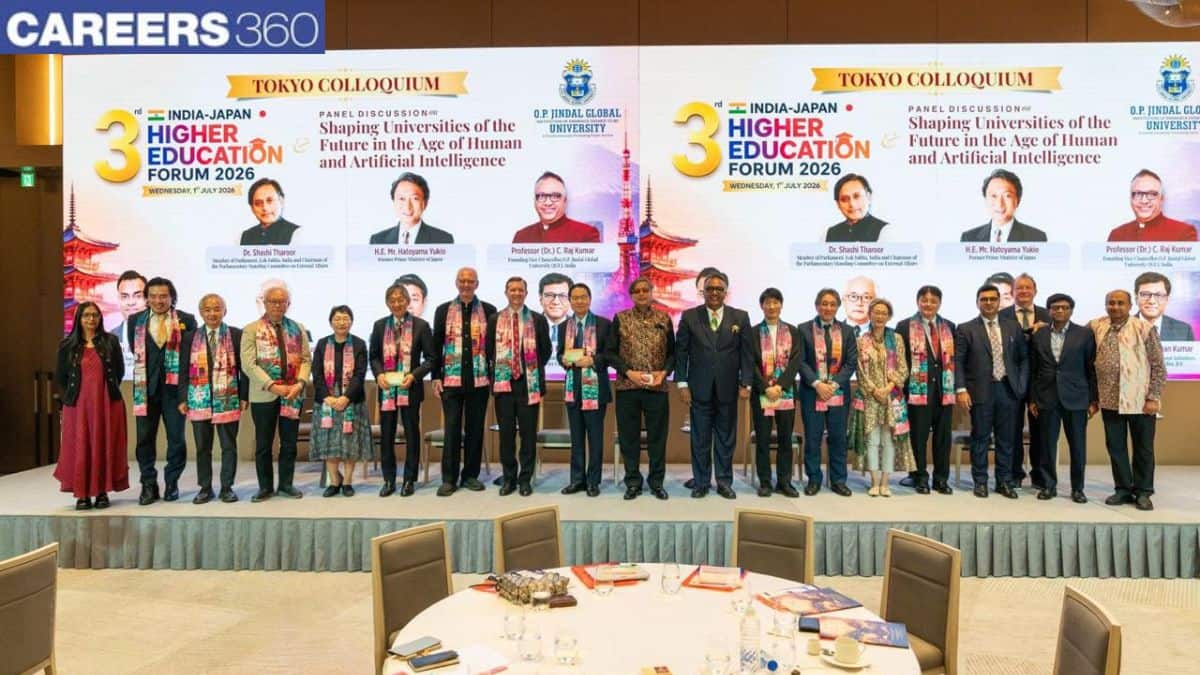
It assumed special significance in the larger context of the India–Japan Summit between Prime Minister Narendra Modi and Prime Minister Sanae Takaichi, which reaffirmed the depth and future direction of the India–Japan Special Strategic and Global Partnership. At a moment when both nations are advancing cooperation in technology, innovation, artificial intelligence, economic security, resilience, and people-to-people exchanges, the Tokyo Colloquium underscored the indispensable role of universities in providing intellectual, institutional, and human depth to this partnership.
Read More: O.P. Jindal Global University Courses
The Inaugural Session opened with a Welcome Address by Professor (Dr.) C. Raj Kumar, Founding Vice Chancellor of JGU, followed by a Special Address by H.E. Mr. Hatoyama Yukio, Former Prime Minister of Japan. In his reflective address, Mr. Hatoyama remarked: “Japan and India share a relationship that goes beyond diplomacy and contemporary cooperation. It is rooted in a deeper civilisational bond shaped over centuries by Buddhism, ethical thought and spiritual exchange. The philosophy of Yu-ai, or fraternity, speaks to mutual respect, mutual understanding and mutual assistance, and finds a natural resonance with Mahatma Gandhi’s ideals of Ahimsa (Non-Violence) and Sarvodaya (The Welfare of All). In this shared inheritance, Japan and India have the opportunity to offer the world a vision of harmony, human dignity and coexistence, inspired by the timeless Indian wisdom that the world is one family.”
Top B-School: Ranked #9 in NIRF Management Rankings 2025.
UG & PG Scholars’ Round Deadline: 14th Nov’26 | Earn upto 50% merit Scholarship + 10% for top performers | EFMD Accredited | AACSB (USA) & AMDISA Member | Highest CTC 28 LPA
The concluding statement was “Education for young people is inseparable from the creation of our future, and I sincerely hope that deeper collaboration between JGU and Japanese universities will enable more students to participate in mutual exchange, strengthening Japan–India relations in academia, economics and culture.”
Professor (Dr.) C. Raj Kumar then delivered the Inaugural Address, confirming JGU’s long-term commitment to Japan and its vision of universities as enduring bridges between the two nations. A Special Address was delivered by H.E. Mr. R. Madhu Sudan, Chargé d’Affaires, Embassy of India, Tokyo, who conveyed the Mission’s warm support for deeper academic and institutional cooperation between India and Japan and welcomed the Forum as a timely contribution to the two countries’ Special Strategic and Global Partnership.
This was followed by the Keynote Address, delivered by Professor (Dr.) Tomohiko Taniguchi, Former Special Advisor to the Cabinet of Prime Minister Shinzo Abe, who offered a considered perspective on the strategic dimensions of the India–Japan relationship and the role of knowledge, innovation and higher education in shaping the future of the Indo-Pacific and the world at large.
Also Read: O.P. Jindal Global University Admissions
A key highlight was the Distinguished Public Lecture by Dr. Shashi Tharoor, Member of Parliament, Lok Sabha, India, and Chairman of the Parliamentary Standing Committee on External Affairs. Addressing a full and distinguished audience of university leaders, diplomats and students, Dr. Tharoor reflected on the evolving relationship between India and Japan and the role of higher education, ideas and people-to-people engagement in shaping the future of Asia in an age of rapid technological change. In the course of his remarks, he warmly appreciated JGU’s sustained and meticulous efforts in building deep and enduring academic ties with Japan, observing that institutional initiative of this kind embodies the very people-to-people foundations on which lasting bilateral relationships are built.
The session also witnessed the launch of the JGU Sustainability Report 2026 by Professor Padmanabha Ramanujam, Dean, Office of Academic Governance, JGU. The Forum’s Panel Discussion brought together an esteemed gathering of senior leaders from Japan’s leading universities on a single stage. Moderated by Professor (Dr.) C. Raj Kumar, Founding Vice Chancellor of JGU, the panel featured Professor (Dr.) Kaori Hayashi, Executive Vice President, University of Tokyo; Professor (Dr.) Shoichiro Iwakiri, President, International Christian University; Professor (Dr.) Noriyuki Takahashi, President, Musashi University; Professor (Dr.) Miki Sugimura, President, Sophia University; Professor (Dr.) Nobuo Haruna, President, Tokyo University of Foreign Studies; Professor (Dr.) Matthew Wilson, President and Dean, Temple University, Japan Campus; Professor (Dr.) Masahiko Gemma, Vice President, Waseda University; and Hon’ble Mr. Justice Michael D. Wilson, Former Judge, Supreme Court of Hawaii.
The Forum also hosted a Certificate Distribution Ceremony for nearly 200 JGU students who completed Short-Term Study Abroad Programmes (ST-SAPs) at JGU’s partner universities across Japan in Summer 2026, including Chuo University, Kyorin University, Musashi University, Temple University, Japan Campus, the University of Tokyo and the University of Yamanashi. The ceremony was presented by Professor Hinaho Kishi, Assistant Professor and Assistant Director, Office of International Affairs and Global Initiatives, JGU, and Ms. Ananya Lall, a student of the Bachelor of Business Administration (Hons.) programme at the Jindal Global Business School, JGU.
Speaking on the occasion, Professor (Dr.) C. Raj Kumar, Founding Vice Chancellor, JGU, said: “The 3rd India–Japan Higher Education Forum reflects JGU’s abiding commitment to building enduring bridges between India and Japan through higher education, research, innovation, student mobility and sustained dialogue on the future of universities in the age of artificial intelligence. As we embrace the extraordinary possibilities of technology, universities have a responsibility to ensure that artificial intelligence deepens human understanding, advances the public good and strengthens global cooperation. Universities must remain custodians of human values, critical thinking, ethical judgment and public purpose even as they prepare future generations for a rapidly changing world. It is in this union of technological ambition and humanistic purpose that the universities of the future will be shaped, and India and Japan are natural partners in that endeavour.”
Read Also: O.P. Jindal Global University Placements
Professor (Dr.) Akhil Bhardwaj, Executive Dean and Director, Office of International Affairs and Global Initiatives, JGU, said: “JGU’s engagement in Japan extends far beyond a single event. The Forum reflects a larger institutional effort to create meaningful partnerships, deepen student and faculty mobility, and build enduring platforms for sustained academic collaboration between Indian and Japanese universities. The Forum, our study abroad programmes and the breadth of our engagements with partners across Japan together represent a long-term investment in the people-to-people foundations of the India–Japan relationship.”
The 3rd India–Japan Higher Education Forum 2026 affirmed that the future of the India–Japan relationship will not be shaped by governments and markets alone, but also by universities, scholars and students who build trust across cultures, generate new knowledge, and prepare the next generation of leaders in both countries to learn with and from one another.
Disclaimer: The above article is part of the marketing collaboration between O.P. Jindal Global University and Careers360.

On Question asked by student community
Hello Aspirant,
UPES,Dehradun stands out in comparison to other universities as it is offering BBA course in much lesser fees and it provides around 19 BBA courses.The location stands out as it is situated near the foot hills of the Himalayas you can have a lush green area and a

Top B-School: Ranked #9 in NIRF Management Rankings 2025.
UG & PG Scholars’ Round Deadline: 14th Nov’26 | Earn upto 50% merit Scholarship + 10% for top performers | EFMD Accredited | AACSB (USA) & AMDISA Member | Highest CTC 28 LPA
Admissions open for 4 year full time B.A/B.Sc Liberal Arts & B.A/B.Sc (Liberal Arts) Honours with Research
Highest CTC 30 LPA | #9 in Management Category by Times B-School | Merit-Based Scholarship Upto - 50 Crores