School of Liberal Studies and Humanities, UPES Dehradun
Ranked #45 Among Universities in India by NIRF | Get Upto 100% Scholarships


The 18th Annual Doctoral Thesis Conference was jointly organised by the ICFAI School of Social Sciences (ISoSS) and the Indira Gandhi Institute of Development Research (IGIDR), Mumbai. ICFAI School of Social Sciences is a constituent Unit of ICFAI Foundation for Higher Education, Hyderabad. The conference was inaugurated on June 4, 2026 and conducted in a hybrid mode. The two-day conference brought together eminent academicians, researchers, faculty members, and doctoral scholars from across the country.
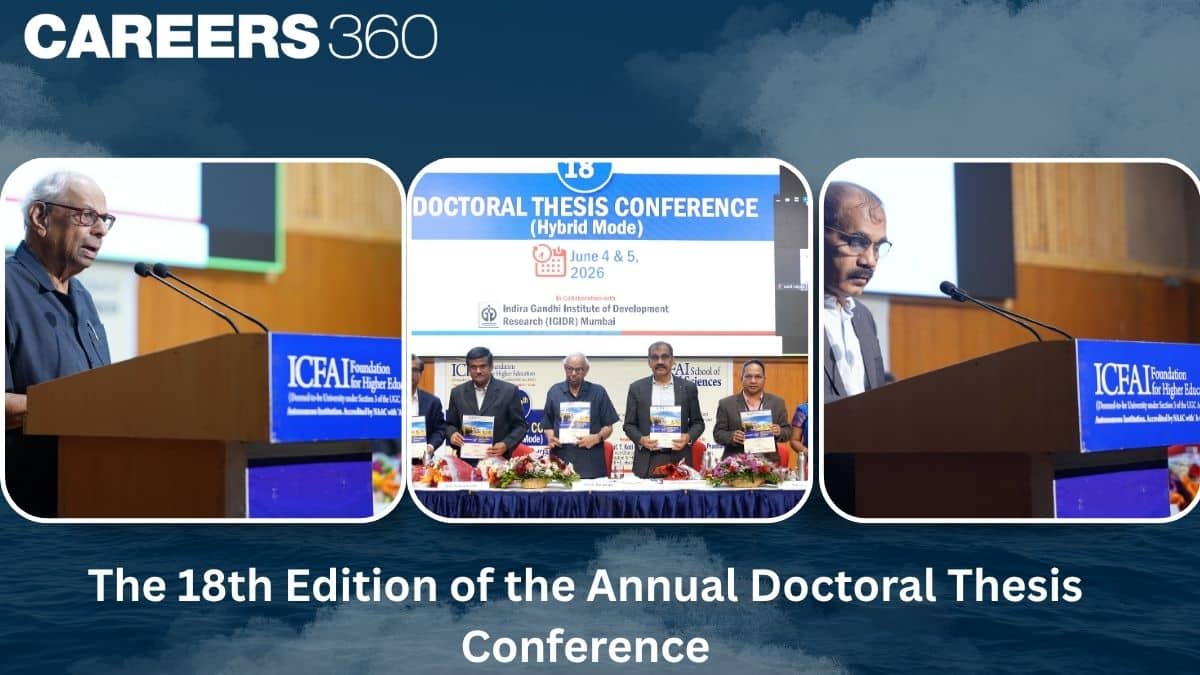
The conference has emerged as a significant academic platform for doctoral researchers to present their work, receive expert feedback, and engage in scholarly dialogue. The strong response to the event, with participation from nearly 200 research scholars representing leading institutions including IIMs, IITs, NITs, IIITs, Jawaharlal Nehru University, and several Central and State universities, reflects its growing importance in India's research ecosystem.
Also See: ISoSS Hyderabad Admission
The keynote inaugural address was delivered by Dr C. Rangarajan, Former Chairman, Economic Advisory Council to the Prime Minister, and Former Governor, Reserve Bank of India, Chancellor, ICFAI Foundation for Higher Education, who underscored the critical role of universities and research institutions in advancing knowledge. Analysing the current economic challenges facing India, he noted that many of the difficulties confronting the country are the result of external or exogenous shocks like the international trade disruptions and tensions in West Asia, rather than domestic weaknesses. These developments have affected global supply chains, increased energy and food prices, and created uncertainty in international financial markets. He emphasised that in spite of a falling rupee, India’s fundamentals remain strong, and the end of the war would revive the value of the rupee. According to him, recent currency pressures have been influenced largely by capital outflows, rather than by structural weaknesses in the economy.
Ranked #45 Among Universities in India by NIRF | Get Upto 100% Scholarships
Application form FREE of Cost for a Limited Period of Time | #11 by NIRF | NAAC A++ Accredited Institution | 1100+ Recruiters
Addressing the policy response to such external shocks, Dr Rangarajan outlined a three-pronged strategy. In the short term, he stressed the importance of diplomatic engagement and diversification of supply sources. In the medium term, he advocated the creation of strategic buffers, particularly in critical areas such as energy security. For the long term, Dr Rangarajan highlighted the need for efficient and selective import substitution in strategically important sectors. He argued that India's objective should not be self-sufficiency at any cost, but rather the development of competitive domestic capabilities in critical areas where excessive dependence on imports may pose risks. He also stressed the importance of accelerating the transition towards alternative and sustainable energy sources, including renewable energy and electric mobility, to strengthen India's long-term energy security and reduce vulnerability to global disruptions. Concluding his address, Dr Rangarajan called upon researchers and doctoral scholars to address contemporary economic and social challenges through rigorous research, robust data analysis, and innovative methodologies.
Also Read: ISoSS Hyderabad Placement
Delivering the special address, Prof. Basanta Kumar Pradhan, Director (Vice-Chancellor), IGIDR, Mumbai, spoke on “The Global Climate Finance Landscape: Concepts, Architecture, and the Road Ahead.” He explained the distinctions among climate finance, green finance, transition finance, and sustainable finance, emphasising the need to avoid greenwashing. Tracing the evolution of climate finance from the Rio Earth Summit and the United Nations Framework Convention on Climate Change to recent global climate negotiations, he discussed changing patterns in climate finance, including the growing role of private finance and project-based funding.
The inaugural session was graced by Dr Tamma Koti Reddy, Vice-Chancellor, IFHE, Hyderabad. Welcoming the gathering, Prof. C. S. Shylajan, Director, ICFAI School of Social Sciences, highlighted the conference's role in nurturing research excellence and fostering intellectual exchange among young scholars and experts from diverse disciplines.
The conference featured technical sessions covering a wide range of disciplines, including Agricultural Economics and Sustainability, Development Economics, Entrepreneurial Development and General Management, Behavioural Economics and Psychology, Finance and Accounting, Health Economics, Human Resource Management and Organisational Behaviour, Macroeconomics and International Economics, Marketing and Business Strategy, and Sociology and Public Policy. The sessions were chaired by distinguished academicians, policymakers, and industry experts who provided guidance and feedback to participating scholars. Paper presentations and academic discussions were made on June 5, 2026.
The ISoSS intends to offer distinctive, high-value education programmes at the undergraduate and postgraduate levels, and promote high-quality research at the master's and doctoral degree levels. Currently, the institution offers a 3-year BA undergraduate and a 2-year MA postgraduate degree programmes in Economics, and a doctoral research programme leading to a PhD.
B.Tech Admissions Open 2026 | #2nd in India by The World University Rankings for Innovation | 200+ Collaborations | 700+ Industry Recruiters
Scholars’ Round Deadline: 14th Nov’26 | Earn upto 50% merit Scholarship + 10% for top performers | EFMD Accredited | AACSB (USA) & AMDISA Member | Highest CTC 28 LPA
Towards internationalising higher education, a 4-year BA Economics Programme leading to an undergraduate degree with Honours or Honours with Research was offered from the 2023-24 academic year. In the academic year 2024-25, the School offers a 3-year B.Sc. (Psychology), a 4-year B.Sc. (Psychology (Honours) and a 4-year B.Sc. (Psychology (Honours with Research). A masters level research program leading to an MS (by research) degree is also being conceived of. Going forward, the ISoSS proposes to offer double-degree programs leading to BA Economics with Psychology, Law, or Data Analytics, or Management.
Disclaimer: This article has been published as a marketing collaboration between Careers360 and ISoSS Hyderabad.


Ranked #45 Among Universities in India by NIRF | Get Upto 100% Scholarships
Application form FREE of Cost for a Limited Period of Time | #11 by NIRF | NAAC A++ Accredited Institution | 1100+ Recruiters
B.Tech Admissions Open 2026 | #2nd in India by The World University Rankings for Innovation | 200+ Collaborations | 700+ Industry Recruiters
Scholars’ Round Deadline: 14th Nov’26 | Earn upto 50% merit Scholarship + 10% for top performers | EFMD Accredited | AACSB (USA) & AMDISA Member | Highest CTC 28 LPA
Highest CTC 30 LPA | #9 in Management Category by Times B-School | Merit-Based Scholarship Upto - 50 Crores
Admissions open for 4 year full time B.A/B.Sc Liberal Arts & B.A/B.Sc (Liberal Arts) Honours with Research