Careers360 Logo
ask-icon
share
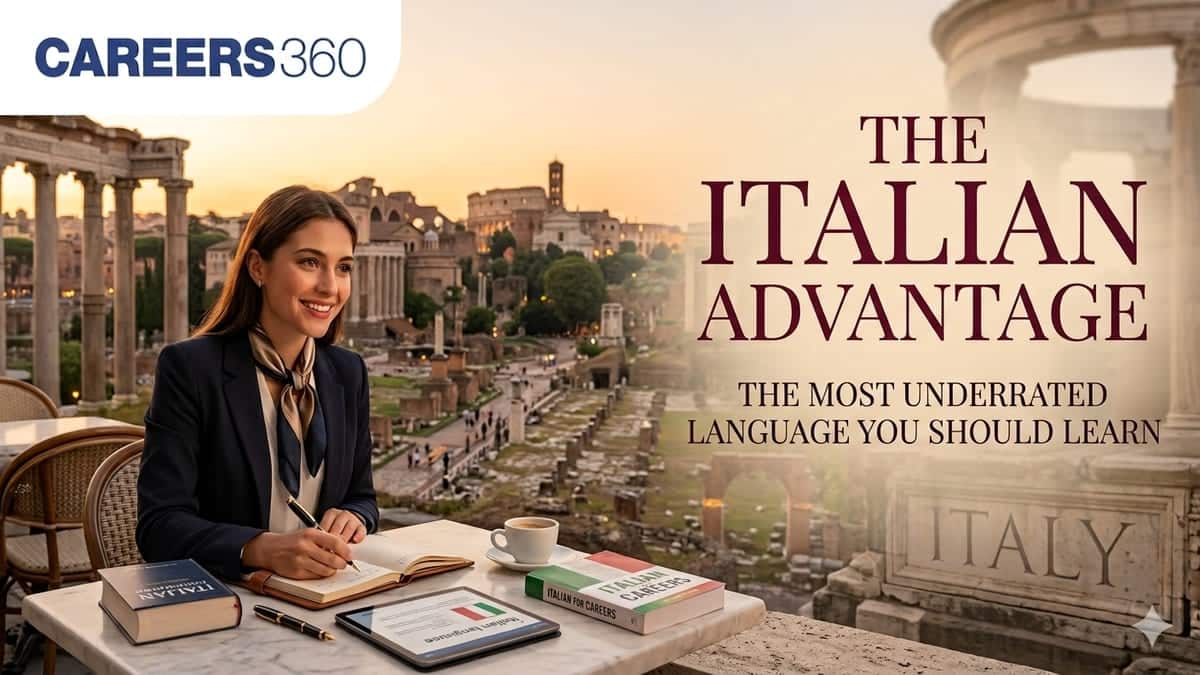
    The Italian Advantage: The Most Underrated Language You Should Learn in 2026
    • Articles
    • The Italian Advantage: The Most Underrated Language You Should Learn in 2026

    The Italian Advantage: The Most Underrated Language You Should Learn in 2026

    Anurag ReddyUpdated on 08 Oct 2026, 05:25 PM IST

    The Italian language is not the most popular language that people wish to learn as a foreign language. But it remains one of the most underrated languages because of lack of awareness about it. The Italian language is considered “easy to learn”. Italian is part of the romance languages and learning this language makes it easier to learn its other romance languages counterparts such as Spanish, French, Portuguese. The market hiring Italian speakers is less competitive, making it the Italian advantage. There lies a vast scope in Italian, in the matters of learning, career and growth. Kindly read the article below to learn about the career options, Italian language courses, Italian proficiency test and more.

    This Story also Contains

    1. Careers Options For Non-Native Italian Speakers
    2. Platforms Providing Jobs Requiring Italian Speakers
    3. Italian Language Degree / Diploma / Certifications Offered in India
    4. Italian Proficiency Test for Non-Native Speakers
    5. Scholarships For Italian Language Learners
    The Italian Advantage: The Most Underrated Language You Should Learn in 2026
    The Italian Advantage: The Most Underrated Language You Should Learn

    Careers Options For Non-Native Italian Speakers

    • LLM Trainer for Italian - Learners speaking Italian can train LLM and AI models by providing them data in Italian.

    • Italian Translator - The translator will fulfil the role to translate text, speech and other media for effective communication and translation. Some of the jobs in translation are translator for corporations, diplomats, government companies; translator for publishing houses; transcriber for media houses.

    • Customer Support - International companies with foreign customer bases require proficient language speakers to converse/ interact with customers.

    • Educator - People who have learned Italian as a second language can teach other people the language.

    • Researcher - Candidates interested to study research in Italy will have an advantage if they speak fluent Italian.

    • Work in Fashion and Design - Work with Italian luxury merchandise and apparel companies.

    • Work in Hospitality - Italy is one of the most sought tourist destinations. They require skilled persons speaking fluent Italian and English, offering highly competitive pay

    • Job Opportunities - Candidates can work for typical office jobs in companies, corporations and organisations in Italy.

    JSS University Sciences Admisisons 2026

    NAAC A+ Accredited| Ranked #24 in University Category by NIRF

    SRM University, Chennai Science and Humanities 2026

    NAAC A++ Accredited | Ranked #12 by NIRF

    Platforms Providing Jobs Requiring Italian Speakers

    • Job Platforms such as - Naukri.com, Indeed, Upwork, LinkedIn, etc.

    • Careers page of corporations/ organisations hiring Non-native Italian speakers

    • Connect and Network with people employed in Italy.

    • Italian Embassy websites for Job in the embassy.

    Italian Language Degree / Diploma / Certifications Offered in India

    • Bachelor’s in Italian language - Universities in India, such as Jawaharlal Nehru University and Delhi University provide full time degree courses in Italian language.

    • Diplomas / Part-time Courses-

    ICFAI Jharkhand B.A Admissions 2026

    Education World: Ranked 2nd in Jharkhand by Education World India Private Universities Ranking-2021

    1. Various universities in India (such as DU, Jamia Milia Islamia) offer certified language diplomas/ part-time courses.

    2. Istituto Italiano di Cultura in New Delhi is offering online/ offline Italian language diploma courses.

    3. Indo-Italian Chamber of Commerce and Industry (IICCI) provides professional diploma courses for foundational, intermediate, and proficient levels.

    • Online certificates - Candidates can learn the Italian language from online learning platforms such as Coursera, Udemy and Preply. These platforms provide certified courses at the comfort to learn the language at your own pace.

    Italian Proficiency Test for Non-Native Speakers

    • CILS (Certificazione di Italiano come Lingua Straniera) - This test is issued under the University for Foreigners of Siena for Italian proficiency that is recognised worldwide for work, study, and citizenship.

    • CELI (Certificato di Conoscenza della Lingua Italiana) - This Italian language proficiency test issued and conducted by the University for Foreigners of Perugia. The test contains a written and an oral exam. It is an internationally recognised test for Italian proficiency.

    Scholarships For Italian Language Learners

    • MAECI Scholarships - The Ministry of Foreign Affairs and International Cooperation (MAECI) offers scholarships to international students with an aim to promote the Italian language and culture and support Italy’s economy.

    • Grants / Financial aid provided by University for Foreigners of Perugia - Offered to international students taking Italian language courses.

    • Grants offered by the Italian Embassy - Learners can connect with the nearest Italian Cultural Institute or local Italian embassy providing financial assistance / grants to promote higher education in Italian language.

    Upcoming University Exams
    Ongoing Dates
    MP SET Others

    26 May'26 - 25 May'27 (Online)

    Questions related to Italian

    On Question asked by student community

    Have a question related to Italian ?

    Question : Comprehension:
    Read the given passage and answer the questions that follow.
    As legend has it, Rome was founded in 753 B.C. by Romulus and Remus, twin sons of Mars, the god of war. They had been left to drown in a basket on the Tiber River by a king of a nearby region and were rescued by a she-wolf. The twins lived to defeat that king and founded their city on the river's banks in 753 B.C. After killing his brother, Romulus became the first king of Rome, which is named after him. A line of Sabine, Latin, and Etruscan (earlier Italian civilisations) kings followed in a non-hereditary succession.
    Rome's era as a monarchy ended in 509 B.C. with the overthrow of its seventh king, Lucius Tarquinius Superbus, whom ancient historians portrayed as cruel and tyrannical, compared to his benevolent predecessors. Rome has now turned from a monarchy into a republic.
    The power of the monarch passed to two annually elected magistrates called consuls. They also served as commanders-in-chief of the army. The magistrates, though elected by the people, were largely the descendants of the original senators from the time of Romulus. In 450 B.C., the first Roman law code was inscribed on 12 bronze tablets-known as the Twelve Tables—and publicly displayed in the Roman Forum. These laws included issues of legal procedure, civil rights, and property rights and provided the basis for all future Roman civil laws. By around 300 B.C., real political power in Rome was centered in the Senate.

    Question:
    What is the passage mainly about?

    Option 1: The Republic of Rome

    Option 2: The history of Rome

    Option 3: The Roman code of law

    Option 4: Roman myths and legends

    Correct Answer: The history of Rome


    Solution : The correct choice is the second option.

    Explanation: It covers the founding of Rome by Romulus and Remus, the transition from a monarchy to a republic, the role of consuls, the creation of the Roman law code (the Twelve Tables), and the

    Question : Comprehension:
    Read the given passage and answer the questions that follow.
    As legend has it, Rome was founded in 753 B.C. by Romulus and Remus, twin sons of Mars, the god of war. They had been left to drown in a basket on the Tiber River by a king of a nearby region and were rescued by a she-wolf. The twins lived to defeat that king and founded their city on the river's banks in 753 B.C. After killing his brother, Romulus became the first king of Rome, which is named after him. A line of Sabine, Latin, and Etruscan (earlier Italian civilisations) kings followed in a non-hereditary succession.
    Rome's era as a monarchy ended in 509 B.C. with the overthrow of its seventh king, Lucius Tarquinius Superbus, whom ancient historians portrayed as cruel and tyrannical, compared to his benevolent predecessors. Rome has now turned from a monarchy into a republic.
    The power of the monarch passed to two annually elected magistrates called consuls. They also served as commanders-in-chief of the army. The magistrates, though elected by the people, were largely the descendants of the original senators from the time of Romulus. In 450 B.C., the first Roman law code was inscribed on 12 bronze tablets-known as the Twelve Tables—and publicly displayed in the Roman Forum. These laws included issues of legal procedure, civil rights, and property rights and provided the basis for all future Roman civil laws. By around 300 B.C., real political power in Rome was centered in the Senate.

    Question:
    Which of the following statements is NOT true?

    Option 1: Elected magistrates served as commanders-in-chief.

    Option 2: Consuls were elected every two years by the people.

    Option 3: Romulus and Remus founded the city of Rome.

    Option 4: Twelve Tables is the Roman code of law.

    Correct Answer: Consuls were elected every two years by the people.


    Solution : The correct choice is the second option.

    Explanation: The correct statement, as mentioned in the passage, is that the magistrates called consuls were elected annually, not every two years. The passage specifies that these consuls were elected

    Question : Comprehension:
    Read the given passage and answer the questions that follow.
    As legend has it, Rome was founded in 753 B.C. by Romulus and Remus, twin sons of Mars, the god of war. They had been left to drown in a basket on the Tiber River by a king of a nearby region and were rescued by a she-wolf. The twins lived to defeat that king and founded their city on the river's banks in 753 B.C. After killing his brother, Romulus became the first king of Rome, which is named after him. A line of Sabine, Latin, and Etruscan (earlier Italian civilisations) kings followed in a non-hereditary succession.
    Rome's era as a monarchy ended in 509 B.C. with the overthrow of its seventh king, Lucius Tarquinius Superbus, whom ancient historians portrayed as cruel and tyrannical, compared to his benevolent predecessors. Rome has now turned from a monarchy into a republic.
    The power of the monarch passed to two annually elected magistrates called consuls. They also served as commanders-in-chief of the army. The magistrates, though elected by the people, were largely the descendants of the original senators from the time of Romulus. In 450 B.C., the first Roman law code was inscribed on 12 bronze tablets-known as the Twelve Tables—and publicly displayed in the Roman Forum. These laws included issues of legal procedure, civil rights, and property rights and provided the basis for all future Roman civil laws. By around 300 B.C., real political power in Rome was centered in the Senate.

    Question:
    Rome became a republic in _____.

    Option 1: 509 B.C.

    Option 2: 450 B.C.

    Option 3: 753 B.C.

    Option 4: 300 B.C.

    Correct Answer: 509 B.C.


    Solution : The correct choice is the first option.

    Explanation: The passage explicitly states: "Rome's era as a monarchy ended in 509 B.C. with the overthrow of its seventh king," signifying the transition from a monarchy to a republic. This date marks the shift in Rome's

    Question : Comprehension:
    Read the given passage and answer the questions that follow.
    As legend has it, Rome was founded in 753 B.C. by Romulus and Remus, twin sons of Mars, the god of war. They had been left to drown in a basket on the Tiber River by a king of a nearby region and were rescued by a she-wolf. The twins lived to defeat that king and founded their own city on the river's banks in 753 B.C. After killing his brother, Romulus became the first king of Rome, which is named after him. A line of Sabine, Latin, and Etruscan (earlier Italian civilisations) kings followed in a non-hereditary succession.
    Rome's era as a monarchy ended in 509 B.C. with the overthrow of its seventh king, Lucius Tarquinius Superbus, whom ancient historians portrayed as cruel and tyrannical, compared to his benevolent predecessors. Rome has now turned from a monarchy into a republic.
    The power of the monarch passed to two annually elected magistrates called consuls. They also served as commanders-in-chief of the army. The magistrates, though elected by the people, were largely the descendants of the original senators from the time of Romulus. In 450 B.C., the first Roman law code was inscribed on 12 bronze tablets-known as the Twelve Tables—and publicly displayed in the Roman Forum. These laws included issues of legal procedure, civil rights, and property rights and provided the basis for all future Roman civil laws. By around 300 B.C., real political power in Rome was centered in the Senate.

    Question:
    Lucius Tarquinius was overthrown because he was a:

    Option 1: descendent of Romulus

    Option 2: cruel monarch

    Option 3: generous ruler

    Option 4: non-hereditary king

    Correct Answer: cruel monarch


    Solution : The correct choice is the second option.

    Explanation: Lucius Tarquinius Superbus was overthrown because he was a cruel monarch. The passage highlights that ancient historians portrayed him as cruel and tyrannical, especially when compared to his benevolent predecessors. This negative portrayal likely

    Correct Answer: Padma Shri


    Solution : The correct answer is Padma Shri.

    Milena Salvini (23 April 1933 – 25 January 2022) was an Italian-born French advocate and instructor of Indian classical dance, particularly acclaimed for her contributions to Kathakali. Awarded the Padma Shri in 2019, Salvini secured a two-year scholarship