Great Lakes Institute of Management, Chennai
Globally Recognized by AACSB (US) & AMBA (UK) | 18 LPA Avg. CTC for PGPM 2026


If you ask any relative or school teacher how to get a software or data job, the answer is pretty much always the same: clear JEE, get a B.Tech degree, or give up on tech. The important question is, is it really necessary to spend four years studying physics, chemistry, engineering drawing, and hardware mechanics really necessary to write Python code?
This Story also Contains
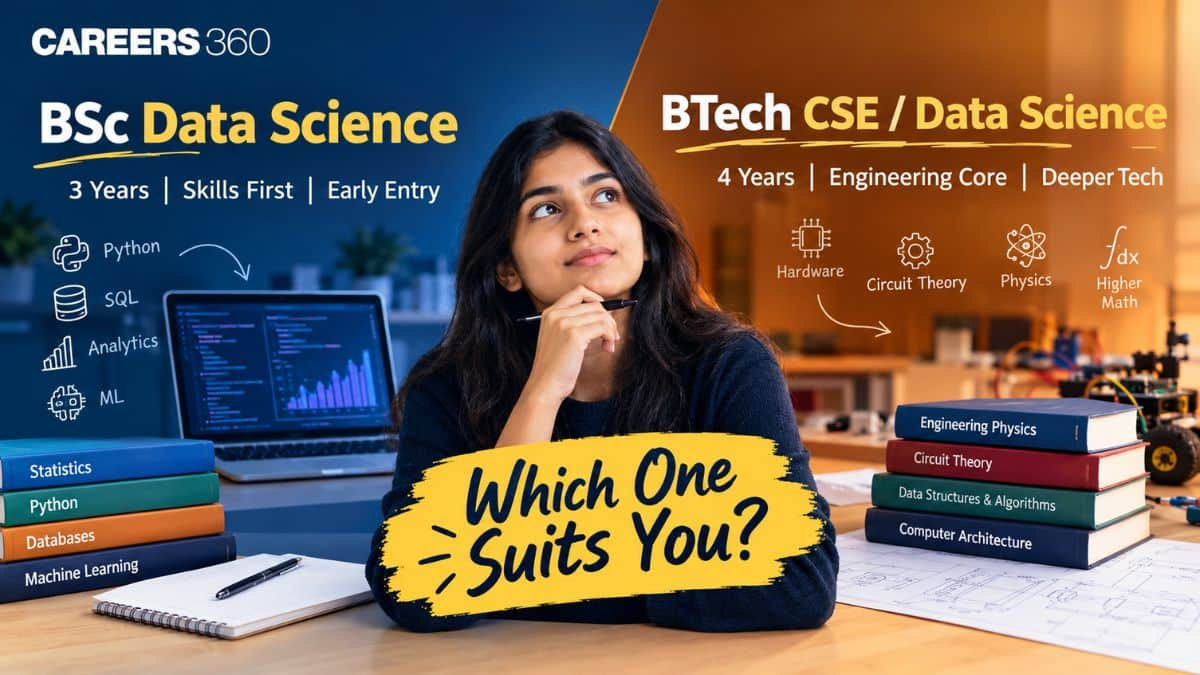
The answer is no, you really do not need a four-year engineering degree to build a successful career in data science or analytics. It is not about which is better for a data science career, BSc or BTech, it is about which one suits you the best.
Course duration: Courses like B.Tech in CSE / Data Science have a duration of 4 years, whereas, B.Sc in Data Science / BCA has a course duration of 3 years.
Curriculum Focus: In BTech, the studies are focused mostly towards Hardware, circuit theory, engineering physics, theoretical math, the BSc/ BCA focuses primarily on Pure application: Python, SQL, statistics, database management, ML tools.
Time required to enter the job market: You need 4 years to complete BTech course, as compared to BSc/ BCA students who need only 3, meaning a full year heads up over BTech.
Math Style: In Btech CSE/ data science, the level of maths is typically higher, focusing on heavy theoretical calculus, differential equations, physics math and more. The BSc data science/ BCA deals with applied statistics, linear algebra, probability, discrete math and more.
Admission Barrier: The entry barrier in BTech is usually higher, where you need to clear entrance exams like JEE, State entrance exams like WBJEE, which usually comes with better preparation with high coaching costs. On the other hand, for BSc data science/ BCA the entry barrier is moderate, admissions are typically offered based on Class 10+2 marks or university level entrance exams or some national level entrance exams like CUET UG exam.
Start learning data science from Semester 1: B.Tech students spend their entire first year on general engineering subjects (chemistry, workshop mechanics, basic electrical engineering), which is irrelevant to you as it will never come in handy for you ever. On the other hand, B.Sc Data Science students start working with data, logic, and databases in Semester 1.
The 1-Year Work Experience Advantage: Job market cares very much about what you know, how long you have been working - if you complete one year early, you have an edge for a year. Graduating a year earlier means you can enter the job market as a Data Analyst or Junior Data Scientist while B.Tech friends are still finishing final-year college exams. One year of real office work routine routinely beats 1 extra year of college theory.
More scope to develop for Real-World Skill Building: B.Sc university schedules are usually less occupied with lab manuals and hardware vivas, giving you time to build a GitHub portfolio, complete internships and more.
Change in HR dynamics: Companies are focused more towards adopting skills-based hiring. During skill tests, it determines your SQL query efficiency and Python code, not your degree name.
The portfolio factor: When it comes to securing the position, a BSc graduate with 3 published, end-to-end data projects on GitHub, a live Tableau dashboard, and a clean LinkedIn profile will anyday beat a BTech graduate who only has classroom marksheets.
Better for entry level roles: Everyone starts at data analyst, BI developer, product analyst or junior data scientist, where business logic, data wrangling and clean queries matter more than system engineering. Once you graduate early, get your working knowledge polished, you are already more valuable than inexperienced BTech graduates.
There are multiple sides to this story, if your priority is building hardwares, IoT devices, robotics or systems software - engineering gives you the ideal ground to evolve. If you plan to work in deep core computer engineering like compilers, operating system design or chip design, streams like BTech CSE are the way to go. If your target university offers top-tier, guaranteed campus recruitment pipelines specifically restricted to 4-year engineering branches, there is no other choice but to go for BTech.
If you want to take a direct route into coding, data analytics and software applications without studying subjects like physics, chemistry, mechanics and more, BSc data science or BCA can be a good option for you. For BSc and BCA, you must be responsible for building practical portfolio projects alongside your college studies.
But, if you want to learn more about hardware engineering and traditional computer science, or if you have already secured a seat in a premier engineering institution with strong campus placement records, BTech can be a better option for you.

Law Admissions 2026 Open | Avail Merit-Based Scholarships
BBA/MBA/PGDM Early Bird Applications Deadline 06th Nov'26. Apply now using coupon code CAREER250 and get ₹250 off the application fee
Ranked #36 amongst institutions in Management by NIRF | 100% Placement
Globally Recognized by AACSB (US) & AMBA (UK) | 18 LPA Avg. CTC for PGPM 2026
Register for XAT 2027 by 28th Oct to become eligible to take the Mock Test | 75+ years of legacy | #1 Entrance Test | 100+ Test Cities | 250+ B-Schools accept XAT Score
Ranked #1 In Business & Economics among Indian Universities (Times Higher Education Rankings 2026)